7 Jobs, 14 Years, No Apology
A Straits Times profile of a comms director with 7 jobs in 14 years is making the rounds — while Singapore's resignation rate sits at a record low. Here's what the data actually says about job-hopping, and why the job count was never the real variable.
7 Jobs, 14 Years, No Apology
Half of Singapore's hiring managers still call job-hopping a red flag. Here's what actually happens to the people who do it anyway — and why the count was never the real variable.
The Straits Times' Headstart On Record podcast recently profiled Annabel Lim, Business & Reputation Director at communications firm We. Communications, who has cycled through seven roles over a 14-year career. Her method was close to engineering: she'd study the job listings for the role she eventually wanted — say, a department head — read exactly what skills and experience it demanded, then choose her next move specifically to close whichever gap was still missing. "It's been a very intentional way to build my career," she says (The Straits Times, Headstart On Record, 2026). Not every move was tidy — her shortest stint was six months, a contract role she took right after quitting a previous job in frustration; she almost walked out on day three, and stayed only to see one project through.
Most of Singapore is doing the opposite
That story lands against an odd backdrop. Singapore's resignation rate hit 1.3% in 2024 — the lowest since records began in 2006 — and stayed near there at 1.2% in the first half of 2025. Among PMETs specifically, the resignation rate was just 0.9%. Average job tenure has climbed to 8.0 years, up from 7.3 a decade earlier (The Straits Times, 2025). Economists are calling it "job hugging": people staying put less out of loyalty than out of fear — of being last hired and first cut, in a year that saw roughly 110,000 tech jobs disappear globally (The Straits Times, 2025, citing Nattavudh Powdthavee, Nanyang Technological University). Set against that, someone volunteering for seven job changes on purpose looks less like an outlier and more like a bet worth examining.
Hugging a job doesn't make it safe
Staying put isn't the guaranteed shelter it feels like, either. Global tech layoffs have already hit roughly 119,000 in 2026 year-to-date — Q1 alone (81,747) topped more than half of all of 2025's total — with Amazon cutting around 16,000 roles, Meta cutting 8,000 (10% of its workforce), and Microsoft cutting another 4,800. More than half of this year's layoff events explicitly cite AI or automation as the driver, even as the same companies pour roughly US$725 billion into AI investment (CNBC, 2026; 247wallst.com, 2026). It isn't only Big Tech, and it isn't only overseas. On 15 July 2026, Singapore's own GovTech retrenched 93 staff — the first of three phases over the next two years — as it shifts from managing projects through vendors to owning and building products itself. Its chairman put it plainly: the skills the agency needs have moved, and the old model can't follow (Mothership.sg, 2026). GovTech is now retraining 110 of its own staff into the roles it needs going forward. That's the same move Lim made for herself, voluntarily, over 14 years — just running on the employer's clock instead of hers.
So is it a red flag, or not?
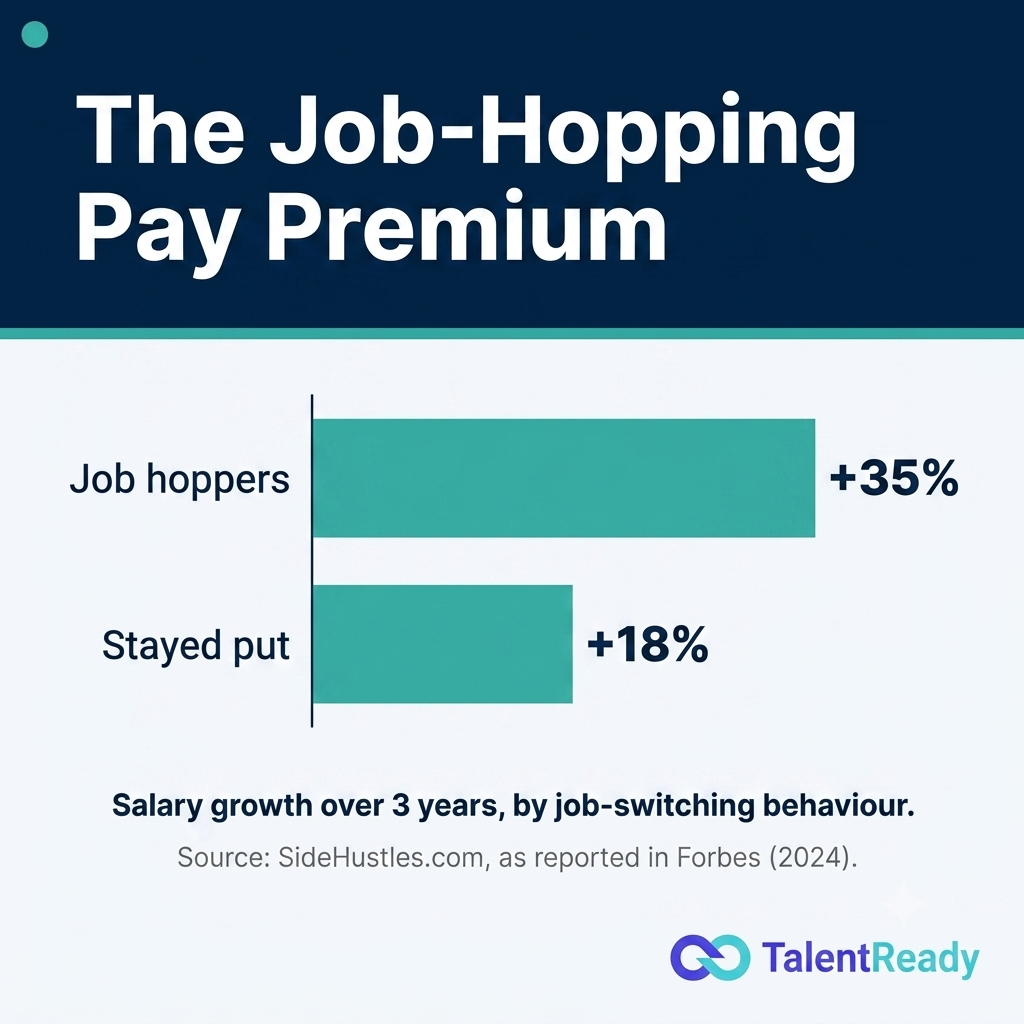
Both, depending who you ask. Half of Singapore hiring managers say a resume showing frequent job changes makes them hesitant to move a candidate forward, and 17% call it an outright dealbreaker (Resume Genius, 2024). But among the people actually doing the switching, 64% say it accelerated their career — and it's not just a feeling. Job-hoppers saw pay grow 35% over three years, against 18% for people who stayed put, and were more than three times as likely to land four or more raises in that span (SideHustles.com, as reported in Forbes, 2024). That premium has since narrowed: US job switchers were up 6.4% year-on-year in January 2026, against 4.5% for those who stayed — the smallest gap since 2020 (ADP, as reported in Fortune, 2026). Narrower isn't gone. Switching still tends to pay. Getting hired to switch is the harder part.
Lim has sat on both sides of that table, and on the hiring side she says the job count on a resume was never actually what she was interviewing for. A candidate who looks like a job-hopper on paper can turn out to be, say, a contract worker in the arts sector who moves from production to production because that's how the industry is structured — not because they can't hold a role down. Her rule as a hiring manager: don't take the resume at face value, ask why (The Straits Times, Headstart On Record, 2026).
The number was never the real variable
Here's what "red flag or not" misses: a hiring manager hesitating at "seven jobs in fourteen years" isn't actually evaluating seven jobs. They're pattern-matching on the one number a resume gives up fastest — job count, or average tenure. Lim draws the line differently — not on how long someone stayed, but on why they left and what each move was for. Her own seven moves and someone else's seven moves are not the same data point. One can show escalating scope and a coherent through-line, each role chosen to close a specific gap; the other can show someone who never found footing. A tenure count can't tell the two apart. Only the substance of what each job actually added can.
Where TalentReady fits
This is the case for reading the whole career, not counting the jobs in it. TalentReady's AI matching evaluates your actual scope, outcomes, and skill transfer across every role you've held — not how long you sat in each one — so a deliberate, escalating career like Lim's scores on what it demonstrates, not on how it reads to a recruiter skimming for red flags in six seconds.
One thing to do this week
Borrow Lim's method directly. Pick one role you're eyeing next — even loosely — and read a real listing for it the way she read hers: what skills does it actually ask for, and which ones are missing from your resume today? Then look back at your own job history not as a list of tenures, but as a chain of additions. For each role you've held, write one line on what capability, network, or scope it gave you that the last one didn't. If a role doesn't have an answer, that's useful too — it's the one move you might want to explain, rather than the one you assume needs defending.
TalentReady is Singapore's AI job matching platform built for mid-career professionals. Sign up free at talentready.sg.
References
The Straits Times. (2026, July 20). 7 jobs in 14 years: A comms director explains why job hopping isn't always bad [Headstart On Record podcast]. straitstimes.com
The Straits Times. (2025, November 19). 'Job hugging' up as resignation rates in S'pore at record lows, average job tenure rises to 8 years. straitstimes.com
Resume Genius. (2024). 2024 Hiring Trends Report: What makes a great job candidate? resumegenius.com
Robinson, B. (2024, November 5). 64% of job hoppers say frequent moves boost career mobility and salary (citing SideHustles.com survey data). Forbes. forbes.com
Fortune. (2026, February). ADP pay trends report on job-switcher vs. job-stayer wage growth. Fortune, as republished by Yahoo Finance. finance.yahoo.com
CNBC. (2026, April 24). 20,000 job cuts at Meta, Microsoft raise concern that AI-driven labor crisis is here. cnbc.com
247wallst.com. (2026, May 7). Tens of thousands of tech workers are being laid off in 2026. The $725 billion that replaced them is going to four companies. 247wallst.com
Mothership.sg. (2026, July 15). GovTech retrenches 93 staff in 1st of 3 phases over next 2 years, shifting to new operating model. mothership.sg
Note. The Annabel Lim material (her hiring-side "ask why" view, the skill-gap job-search method, the six-month contract role, the direct quote) is drawn from the Headstart On Record podcast episode published 20 July 2026. The "job hugging" statistics (resignation rates, average tenure, tech layoff figure, Powdthavee quote) are cited as they appear in a Nanyang Business School (NTU) summary of the original Straits Times article (2025, November 19). The global tech-layoff figures (119,000 YTD, the Q1/81,747 figure, Amazon/Meta/Microsoft counts, the 54% AI-driver stat, and the $725B AI capex figure) are cited via secondary reporting from CNBC and 247wallst.com.