AI Can Win You the Interview. It Can't Do the Job
The Straits Times reports 13% of job hunters now admit to using a chatbot live during interviews — and employers are getting burned once the hire starts. Here's why the interview was never a reliable signal, and what mid-career professionals should check instead.
AI Can Win You the Interview. It Can't Do the Job.
13% of job applicants now admit to running a chatbot live during interviews — why that's good news if your experience is real
The Straits Times reported this week that a New York City non-profit hired a candidate for a grant-writing role after interviews that were polished, if a little scripted. Within a month, his boss realised he could not do the project he had interviewed for — he "froze on basic decisions and was far less nimble than he had seemed from behind a screen." Looking back, the clues were there: generic answers, language lifted straight from the organisation's website, tidy three-part responses to almost every question. The manager now feels almost certain he was covertly consulting a chatbot during the virtual interviews (The Straits Times, 2026, citing Bloomberg).
This isn't a one-off
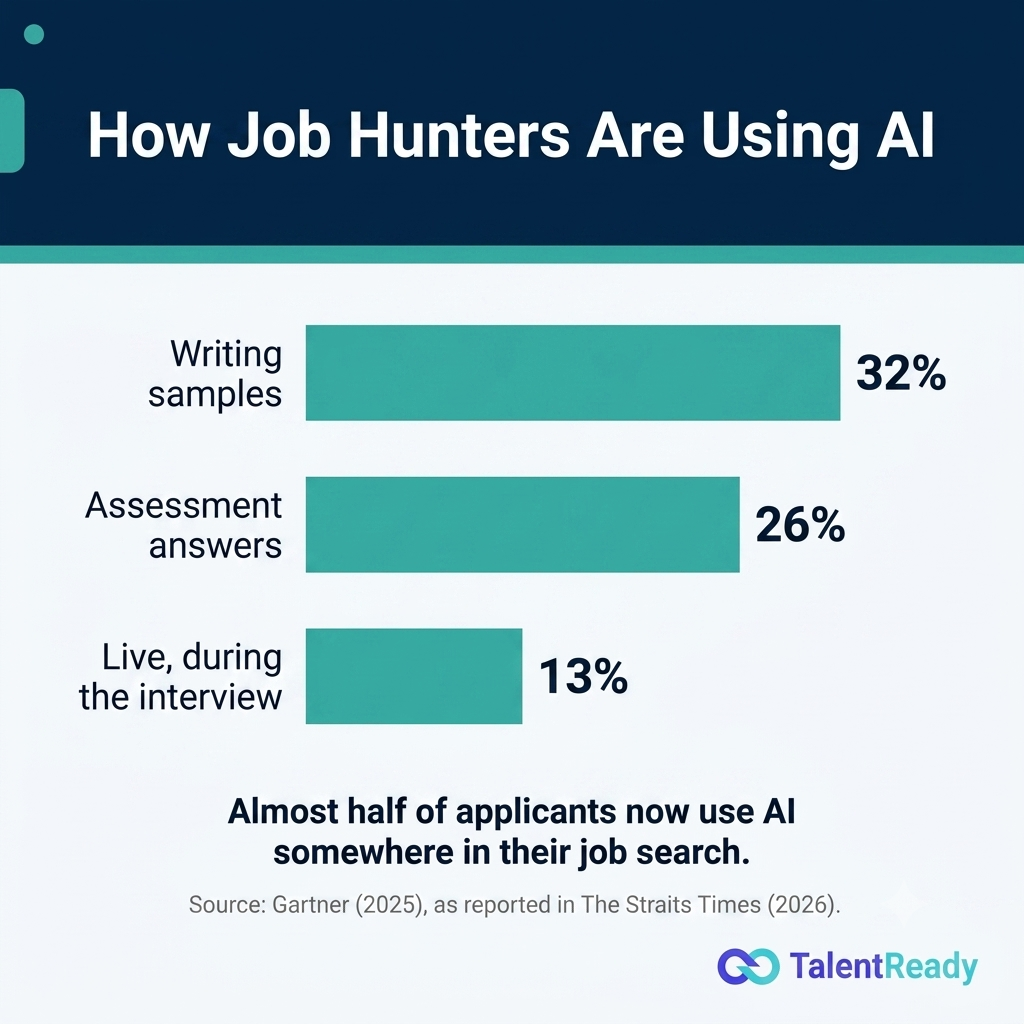
Almost half of job applicants say they've used AI at some point in their job search, per Gartner data from late 2025 — up from about 40% in 2024. Most of that is benign: polishing a resume, drafting a cover letter. But 32% say they've used AI to generate writing samples, 26% to answer assessment questions, and 13% admit to running a chatbot live during the interview itself (Gartner, 2025, as reported in The Straits Times, 2026). Gartner director Caroline Ogawa says HR teams are seeing a rise in what the industry calls "regrettable hires," and ties part of that rise directly to candidates leaning too heavily on AI to get through the door.
Employers are already redesigning around it
The tells recruiters describe are specific: eyes darting across the screen, oddly generic answers, suspiciously tidy three-part structures to every question. Telepatia's Herval Freire started throwing in a question about hobbies mid-interview, specifically to catch candidates who lose the thread once the script runs out. Some companies aren't waiting for a tell. Google now includes at least one in-person round for nearly every software engineering hire, L'Oreal has designated some interview stages an "AI-free zone," and Anthropic bars AI use in live interviews and take-home evaluations unless explicitly authorised (The Straits Times, 2026). This isn't paranoia for its own sake — a bad hire is expensive: filling a role runs employers roughly US$1,300 in direct cost, before onboarding time and lost productivity (Society for Human Resource Management, as reported in The Straits Times, 2026).
Why this isn't really a new problem
Strip away the AI framing and this is an old problem wearing a new coat. A single unstructured conversation has never been a reliable predictor of job performance — decades of personnel-selection research put its correlation with actual on-the-job performance at roughly 0.38, weaker than structured interviews, work-sample tests, or a candidate's documented track record (Schmidt & Hunter, 1998). AI didn't break a sound hiring signal. It found the weakest link already there and pulled.
Why "get better at reading the room" isn't the fix if you're 40+
The obvious employer response — sharper questions, more scrutiny, a sharper eye for anything that feels rehearsed — sounds reasonable until you consider who that scrutiny lands hardest on. Jobseekers aged 50 and above already report facing age discrimination in Singapore's job market at more than three times the rate of those under 50 — 37.9% versus 12.2% (Ministry of Manpower Singapore, 2024). An interview process that leans harder on gut-feel and on-the-spot impression, because employers no longer trust the polish, is a process that leans harder on exactly the kind of snap judgment where that bias already lives. Getting better at performing under pressure isn't the fix. Not needing the performance to carry the whole decision is.
Where TalentReady fits
This is the case for evaluating people on what they've actually done, not on forty-five minutes of live performance. TalentReady's AI matching reads your career depth and demonstrated experience directly from your profile — the roles you've held, the scope you've carried, the outcomes you can point to — and scores you against a job before either side is ever in a room together. A good interview day or a bad one still matters once you're talking to an employer, but it isn't the only signal carrying the decision, and it was never going to be a fair one to lean on entirely.
One thing to do this week
Pull up your TalentReady profile, or your resume if you haven't built one yet, and read each bullet as if you were the hiring manager deciding whether to trust it without meeting you first. Does it name a scope — team size, budget, portfolio — a decision you made, or a number that moved because of you, or does it describe a duty anyone in the role could claim? The goal isn't to sound more impressive. It's to make sure the written record can carry its share of the case, so the conversation isn't the only place your experience gets to prove itself.
TalentReady is Singapore's AI job matching platform built for mid-career professionals. Sign up free at talentready.sg.
References
The Straits Times. (2026, July 15). Job hunters are using AI to cheat in interviews and failing at the office (Bloomberg). straitstimes.com
Ministry of Manpower Singapore. (2024). Fair employment practices report 2023. mom.gov.sg
Schmidt, F. L., & Hunter, J. E. (1998). The validity and utility of selection methods in personnel psychology: Practical and theoretical implications of 85 years of research findings. Psychological Bulletin, 124(2), 262-274.
Note. The Gartner usage statistics (32%/26%/13%) and the Society for Human Resource Management cost-per-hire figure are cited as they appear secondhand within the Straits Times article (a Bloomberg wire story). All other facts and the direct quote in the opening anecdote are drawn from that same Straits Times article.