How to Pivot Your Career at 40 in Singapore: A Practical Guide
Thinking about a career change but not sure where to start? Here's what mid-career professionals in Singapore need to know — and do — to make a successful pivot.

Is It Too Late to Change Careers at 40?
Short answer: no. In fact, mid-career professionals in Singapore are changing careers more successfully than ever — and employers are increasingly open to it.
The longer answer is that a career pivot at 40 looks different from one at 25. You're not starting from zero. You have 15–20 years of skills, relationships, and hard-won expertise that most young applicants simply don't have. The challenge isn't capability — it's positioning.
This guide covers what you actually need to do to make a successful career transition in Singapore, step by step.
Why Mid-Career Pivots Are More Common Than You Think
Singapore's workforce is undergoing a structural shift. The rise of flexible work, project-based contracts, and part-time arrangements means that employers are hiring for skills, not just for linear career paths.
SkillsFuture data shows that over 30% of working Singaporeans aged 40–55 have considered a career change in the past two years. Economic changes, industry disruptions, and evolving personal priorities are driving this shift — and organisations are adapting to meet it.
The result: there are more legitimate pathways for a mid-career pivot today than at any point in the last two decades.
Step 1: Identify Your Transferable Skills
The most common mistake mid-career professionals make is thinking only in terms of job titles. Instead, think in capabilities.
Ask yourself: what can I actually do well, regardless of what it was called in my last role?
Common transferable skills that travel across industries:
Stakeholder management — valuable in consulting, project management, sales, HR
Data analysis — applies anywhere from finance to marketing to operations
Process improvement — manufacturing, logistics, healthcare, tech
Team leadership — nearly every industry values experienced managers
Client relationships — banking, insurance, professional services, B2B tech
Technical writing / documentation — IT, compliance, education, government
Write these down. They are your pivot assets.
Step 2: Find the Industries That Value What You Know
Not all career pivots require starting from scratch. Many involve moving from one industry to an adjacent one where your skills are valued — even if the job title changes.
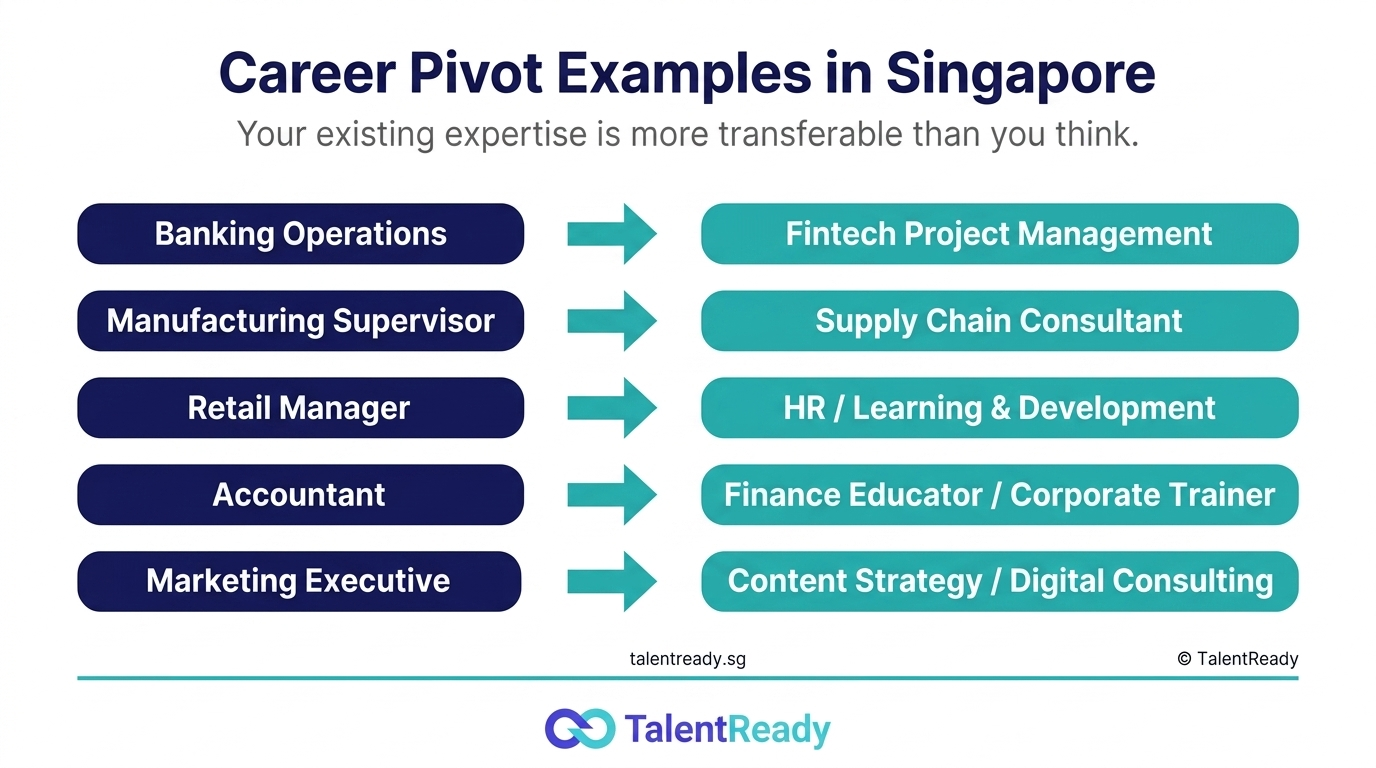
Example pivots that work well in Singapore:
Banking operations → Fintech project management
Manufacturing supervisor → Supply chain consultant
Retail manager → HR or learning & development
Accountant → Finance educator or corporate trainer
Marketing executive → Content strategy or digital consulting
The key is finding where your existing expertise translates directly into value for a new employer — and being able to articulate it clearly.
Step 3: Update Your Resume for a Career Pivot
A mid-career pivot requires a different resume approach than a standard job search. Your goal is to lead with relevance, not history.
What to change on your resume
Rewrite your professional summary to speak directly to the new role you're targeting — not the one you're leaving
Lead each job entry with transferable achievements, not just role responsibilities
Use keywords from job descriptions in your target field — ATS systems filter on these
Remove or condense older roles that aren't relevant (pre-2010 experience rarely needs more than 2–3 lines)
What not to do
Don't list every job you've ever had — curate ruthlessly
Don't use a functional resume with no employment history — it raises red flags with recruiters
Don't apologise for the change — frame it as a deliberate, forward-looking decision
Step 4: Know How Hireable You Are Before You Apply
One of the most demoralising parts of a job search is sending out applications and hearing nothing back. This is often not about your experience — it's about how well your profile matches what employers are actively hiring for right now.
This tells you two things: which roles you match well right now, and where the gaps are. Both are useful before you spend weeks tailoring applications.
Step 5: Choose the Right Work Arrangement
One of the biggest advantages of a mid-career pivot in Singapore today is the range of work arrangements beyond full-time employment:
Project-based — work on a defined scope for 3–12 months; good for testing a new field with low commitment on both sides
Part-time — 3–4 days per week; common in finance, HR, compliance, and admin roles
Flexi-work — variable hours within agreed output targets; increasingly standard post-COVID
Work from home — available in most knowledge-work roles across Singapore
Starting with a project-based or part-time role in your target field lets you build a track record in the new industry before committing fully — and gives employers a low-risk way to try working with you.
Step 6: Tap Into Singapore's Career Support Ecosystem
Singapore has a strong ecosystem of support for career transitions — much of it underused:
SkillsFuture Credit — S$500 per Singaporean aged 25+, with additional top-ups for mid-career workers aged 40 and above
Career Conversion Programmes (CCPs) — Workforce Singapore-funded schemes that subsidise employers to hire and retrain mid-career switchers
SGUnited Mid-Career Pathways — training and company attachment programmes across multiple sectors
e2i and NTUC — career coaching, resume workshops, and job matching services
Many professionals don't realise that ACRA-registered employers can receive government funding when they hire mid-career switchers. This makes experienced candidates more attractive — not less — to employers who understand how to hire smartly.
The Bottom Line
A career pivot at 40 in Singapore is not only possible — for many professionals, it's the smartest move they can make. Your skills, experience, and professional maturity are genuine assets. The key is translating them clearly for a new audience.
Start with what you know you're good at. Understand how those skills map to your target field. Update your resume to speak to that field directly. And before you apply anywhere, know how you measure up against what employers are actually hiring for right now.