Don't Wait to Be Retrenched to Prepare
Retrenchments in Singapore hit a five-year high in Q2 2026. Most people's backup plan is a government scheme they've heard of but never actually checked — and for many mid-career professionals, it isn't the cushion it sounds like. Here's the real number to plan around.

Don't Wait to Be Retrenched to Prepare
If your industry has felt uneasy lately, you're not imagining it. Retrenchments in Singapore climbed through the first half of 2026 — from 3,830 in the first quarter to 4,620 in the second, the highest quarterly total since the last quarter of 2020. The rise was mostly in outward-facing sectors like info-comms and manufacturing (Ministry of Manpower Singapore, 2026).
MOM's own read is that this is business restructuring, not a wider downturn. Jasmin Lau, Acting Minister for Manpower, said as much in August: "At this point, we don't see that much substitution of workers by technology." In her view, the bigger driver right now is companies reorganising — not AI replacing people (Tan, 2026).
Job numbers kept growing every quarter, and retrenchment levels are still well below what a real downturn usually looks like. Still, it's enough to ask a blunt question before it happens to you, not after: if you lost your job tomorrow, what would you actually have to live on for the next six months?
Most people's answer involves a number they've heard of but never actually checked: the SkillsFuture Jobseeker Support scheme, up to $6,000 over six months. It sounds like a real safety net. For a lot of professionals, it isn't one at all — and finding that out after you're retrenched, instead of before, is an expensive way to learn it.
The number most professionals don't know
To qualify for that $6,000, you need to have earned $5,000 a month or less, on average, over the past year. Look at the real market wage data we've covered on this blog — Business Analyst, Manufacturing Manager, most degree-holding PMET roles — and the typical professional-track salary clears that line easily. If your last job paid anywhere near what a mid-career PMET usually earns, the honest answer is: you probably don't qualify for this scheme at all.
That's not a guess. Of roughly 7,200 applications the scheme has received, 60% were rejected — most often because the applicant wasn't judged to be involuntarily unemployed, with going over the $5,000 income cap close behind as a reason. NTUC's leadership has been asking the government since February to raise that cap to $7,600, closer to what a typical PMET actually earns. As of today, it hasn't moved. (If the income cap rules you out, NTUC's e2i runs career coaching with no income limit attached — worth knowing about either way.)
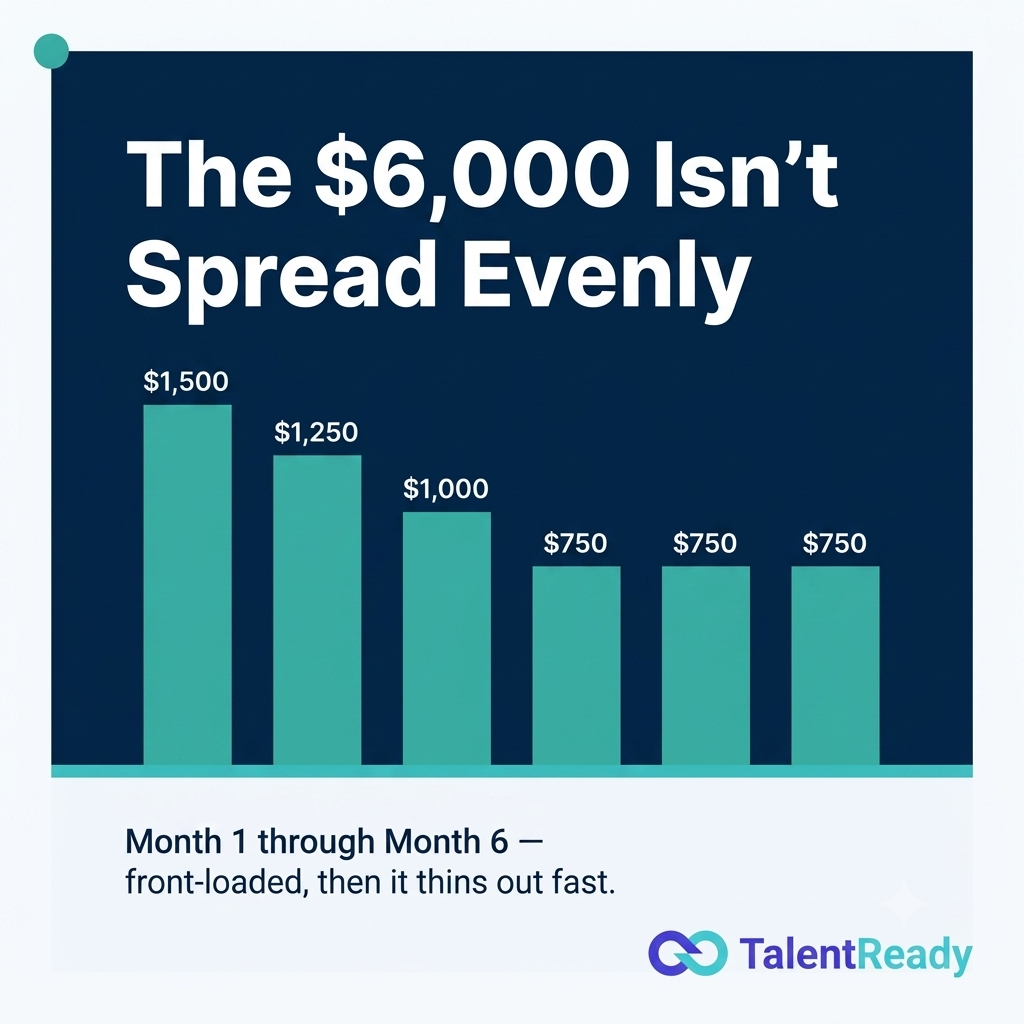
Even applicants who do qualify wait a full month with no payout before the scheme starts. And the $6,000 isn't spread evenly — it's front-loaded: $1,500 in month one, tapering down to $750 by month four.
What actually closes the gap
This isn't a reason to panic. But if job loss does happen, what actually closes the gap isn't a bigger payout — it's speed. How fast you land the next role, at a fair number. And unlike scheme eligibility, that part is within your control. Financial pressure is exactly when people take a lowball offer just to stop the bleeding — and that resets your pay baseline for years, not just six months. TalentReady puts both pieces in one place the moment you sign up: AI-matched job openings built for your actual experience, and your salary benchmark against real market data, so urgency doesn't talk you into underselling yourself.
If you're not job-hunting yet — just reading this because your industry feels uneasy — the smarter move is to act early, while it's still low-stakes. Signing up costs nothing and takes minutes. Think of it as keeping a free option open. If none of this happens to you, you've lost nothing. If it does, you're not starting from zero — your profile, your benchmark and your matches are already there waiting.
Plan around the real number, not the reassuring one
If job loss is a real worry for you right now, plan around the number that's actually true for you — not the one that sounds comforting. For most mid-career professionals, the real safety net is personal savings, not a government scheme built for lower-income workers. Budget for that, before you need to.
Sign up free at talentready.sg.
The safety net is smaller than most professionals assume. Worth knowing before you need it, not after.
TalentReady is Singapore's AI job matching platform built for mid-career professionals. Sign up free at talentready.sg.
References
Ministry of Manpower Singapore. (2026, June 15). Labour Market Report, First Quarter 2026. stats.mom.gov.sg
Ministry of Manpower Singapore. (2026, September 21). Labour Market Report, Second Quarter 2026. stats.mom.gov.sg
Ministry of Manpower Singapore. (2025, September 23). Written answer to Parliamentary Question on SkillsFuture Jobseeker Support scheme. mom.gov.sg
Ministry of Manpower Singapore. (2024, August 27). SkillsFuture Jobseeker Support, including Annex A — Factsheet on SkillsFuture Jobseeker Support scheme. mom.gov.sg
Skills & Workforce Development Agency. (n.d.). SkillsFuture Jobseeker Support scheme — eligibility criteria. swda.gov.sg
Mothership.SG. (2026, February). Labour chief Ng Chee Meng calls to raise income threshold for Jobseeker Support Scheme.
Tan, F. (2026, August 22). Retrenchments are due to restructuring, not AI: Jasmin Lau. The Edge Singapore. sg.finance.yahoo.com
Note. Eligibility criteria, payout schedule ($1,500/$1,250/$1,000/$750/$750/$750 over months 1–6) and the one-month unemployment wait before first payout are drawn directly from MOM's official Annex A factsheet and cross-checked against SWDA's current eligibility page. Rejection-rate and ranked reason figures are as of 31 August 2025 (7,200 applications, 60% rejected) — the most recent published breakdown at time of writing, verbatim from MOM's written parliamentary answer, which ranks reasons rather than giving a percentage per reason. The $5,000 monthly income threshold and $7,600 proposed alternative are current as of the Budget 2026 parliamentary debate; readers should verify against the latest scheme terms at go.gov.sg/jobseekersupport before relying on them, as MOM has stated the threshold remains under review. Retrenchment figures (3,830 in 1Q 2026, 4,620 in 2Q 2026) are drawn from MOM's Q1 2026 and Q2 2026 Labour Market Reports respectively, both published directly by MOM. The 2Q figure was revised up from MOM's preliminary advance estimate of 4,500 when the full quarterly report was published on 21 September 2026. Jasmin Lau's quote is taken from her remarks at the DBS Treasures Wealth Symposium, 22 August 2026, as reported by The Edge Singapore.