Beyond Keywords: The Holistic Matching Approach That’s Changing How Mid-Career PMETs Find Work in Singapore
Keyword matching was designed for fresh graduates — not for professionals with 20 years of demonstrated impact. Here's why the standard approach systematically fails mid-career PMETs, and how TalentReady's holistic AI matching was built to read a senior career the way it deserves to be read.

Beyond Keywords: The Holistic Matching Approach That’s Changing How Mid-Career PMETs Find Work in Singapore
You have 20 years of experience. You have managed teams, owned P&L, restructured operations, led cross-functional projects, and navigated multiple economic cycles. You know more about what it actually takes to run a business than most people in the room.
Then you upload your resume to a job platform. It scans your profile. It gives you a score. And it matches you with jobs based on how many keywords in your resume appear in the job description.
Twenty years of experience. Reduced to a keyword count.
This is the fundamental problem with how most job platforms work — and it hits mid-career professionals harder than anyone else.
Why Keyword Matching Was Never Built for You
Keyword matching was designed for early-career hiring. When a company is hiring a fresh graduate or an associate with two years of experience, the most useful filter is: does this person list the right skills? Have they studied the right things? Do they have experience with the specific tools we use?
That logic makes sense at the start of a career. It completely breaks down once someone has been working for 15, 20, or 25 years.
Here’s why.
Problem 1: The same title means radically different things
Take “Project Manager.” A keyword system gives that title the same weight at every career stage. But a Project Manager at 28 managing a three-person team delivering a single product update is a fundamentally different professional from a Project Manager at 52 who has run programmes with 40 people across four countries, managed $20M budgets, and led organisational change initiatives.
Keyword matching cannot see this difference. It sees the same two words.
Problem 2: The most valuable parts of a senior profile live in the descriptions
Twenty years of career growth cannot be captured in a skills tag list. The things that make an experienced professional genuinely valuable — their judgment, their leadership approach, their track record under pressure, the scale and complexity of the problems they’ve solved — are only legible in the actual text of their career history.
Keyword systems don’t read those descriptions. They scan for specific terms and count matches. The richest part of a mid-career profile is invisible to them.
Problem 3: Cross-industry experience looks like a mismatch
Many of the most transferable skills in a senior career — operational leadership, stakeholder management, financial oversight, team building — are not industry-specific. A COO who has run operations across manufacturing, logistics, and retail brings capabilities that are genuinely relevant to a fintech or healthcare organisation looking for operational maturity.
But keyword systems trained on job-description matching will flag this as a poor fit. The industry label does not match. The score drops.
The professional is effectively penalised for having breadth.
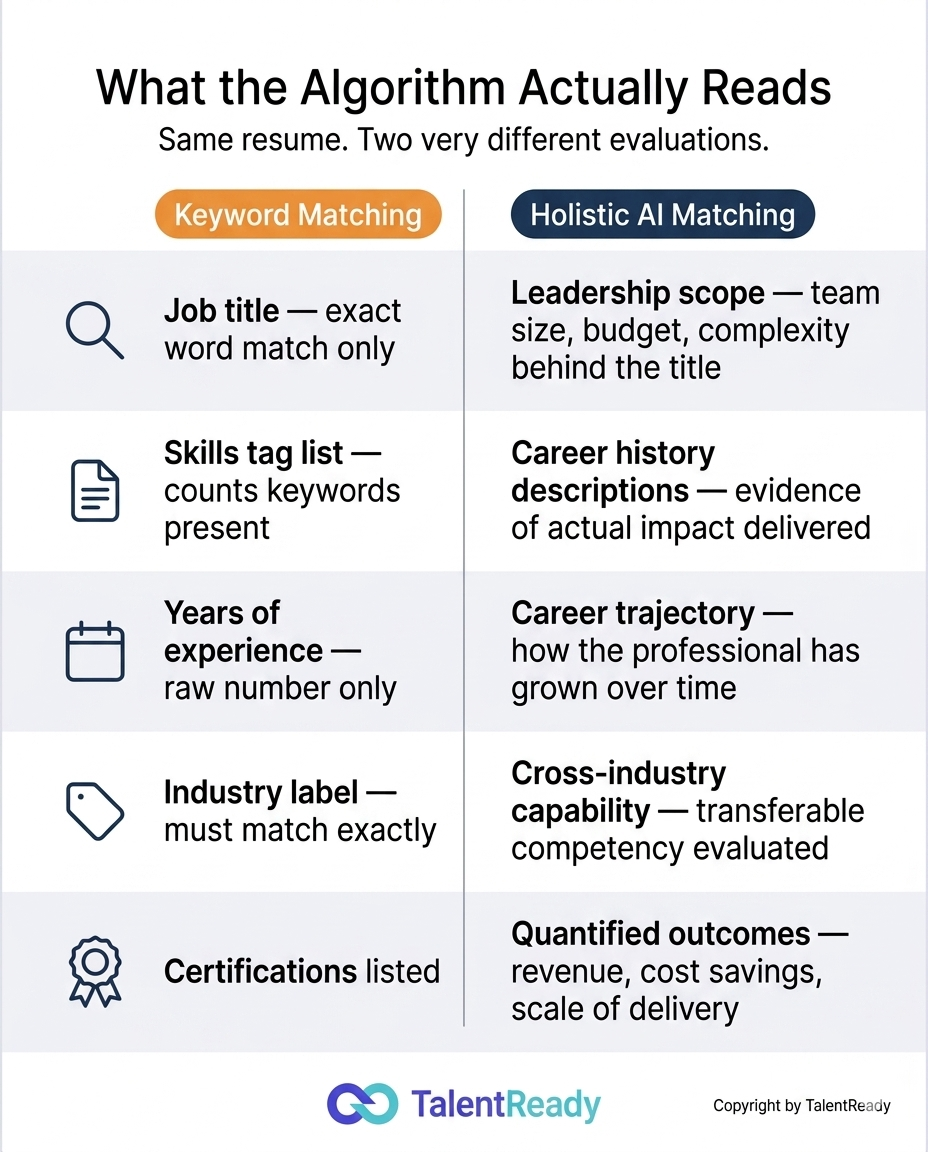
Keyword Matching vs Holistic Matching: What Actually Gets Evaluated
What Holistic AI Matching Means
TalentReady was built around a different principle:
A mid-career professional’s value is the sum of their demonstrated impact, not the count of their keyword matches.
Holistic matching means the AI reads your career history the way a senior recruiter would — looking for what you have actually done and delivered, not just what terms appear on the page.
Instead of scanning for keyword frequency, TalentReady’s AI evaluates career history descriptions for evidence of:
• P&L ownership at any scale — professionals who have managed revenue, cost, or financial outcomes directly
• Team leadership — professionals who have built, grown, restructured, or mentored teams
• Problem-solving complexity — multi-stakeholder, cross-functional, or turnaround experience
• Strategic contribution — professionals who have authored or executed plans that moved an organisation forward
• Adaptability — professionals who have deliberately developed new skills, pivoted domains, or kept pace with industry change
These signals live in the way you describe your experience — not in a tag list.
Built-In Bias Correction for Experienced Professionals
There is a well-documented pattern in Singapore’s job market: experienced professionals over 40 are systematically disadvantaged by the way standard job platforms score profiles.
This happens for several reasons:
• Keyword systems reward recency. A professional who has been doing senior strategic work may not have recent entries for foundational skills they mastered a decade ago — so they score lower than a junior candidate who listed those skills last year.
• Breadth looks like dilution. A senior career covering multiple industries or functions gets scored as “unfocused” by algorithms optimised for narrow specialisation.
• Seniority is penalised as “overqualified.” Systems designed to protect entry-level roles from over-experienced candidates apply the same logic to senior roles where that experience is precisely the value.
TalentReady’s AI is specifically designed to correct for these patterns. It credits demonstrated impact and leadership scope rather than penalising seniority, broad background, or the absence of recently typed skill tags.
The goal is not to be charitable. It is to be accurate.
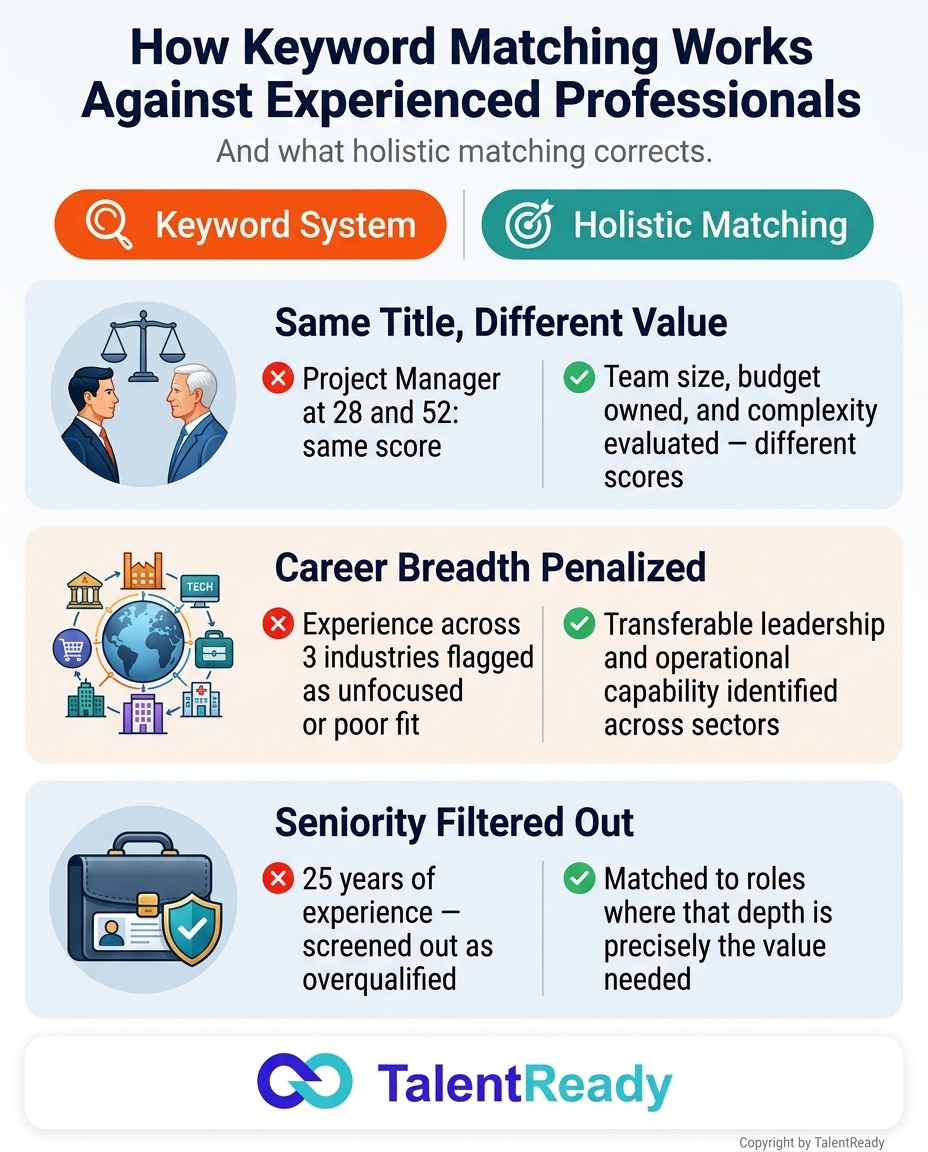
How Keyword Systems Penalise Experience — and What Holistic Matching Fixes
Career-Stage Awareness: Not One Algorithm for Everyone
Experienced professionals are not a monolith. Someone who was retrenched after 25 years in a single industry is in a fundamentally different situation from someone who is deliberately pivoting into advisory work, or someone returning to the workforce after a career break, or someone transitioning from a senior role into a more flexible or part-time arrangement.
These professionals have different goals. They are offering different things. And they should be evaluated differently.
TalentReady’s matching is designed to adapt to a professional’s actual career situation — not to apply a single scoring model to every profile regardless of what stage of career they are at. The AI reads context, not just content.
This matters because a mid-career professional who is open to a step-down role for the right cultural fit is a genuinely different candidate from one who is targeting a step-up with equity participation. Treating them identically — as keyword-matching systems do — produces irrelevant results for both.
What This Means for How You Are Matched
If you have built a TalentReady profile, here is what the matching process is actually looking at:
Your career history descriptions matter more than your skills list. The AI is reading for evidence of demonstrated impact — so the quality and specificity of how you describe your experience has a direct effect on how you are matched. Vague descriptions produce vague matches. Specific, outcome-focused descriptions produce better ones.
Your industry breadth is not held against you. If your career has spanned sectors, the AI is designed to evaluate whether the underlying capabilities transfer — not just whether the industry label matches.
Your seniority is an asset, not a liability. The platform’s matching is designed to surface you for roles where your depth of experience is precisely what the employer needs, not to filter you out for being too experienced.
The AI reads your whole career, not just your most recent role. A 20-year career has a trajectory. The matching process is designed to read that arc and understand what you bring as a whole professional, not just what your last job title was.
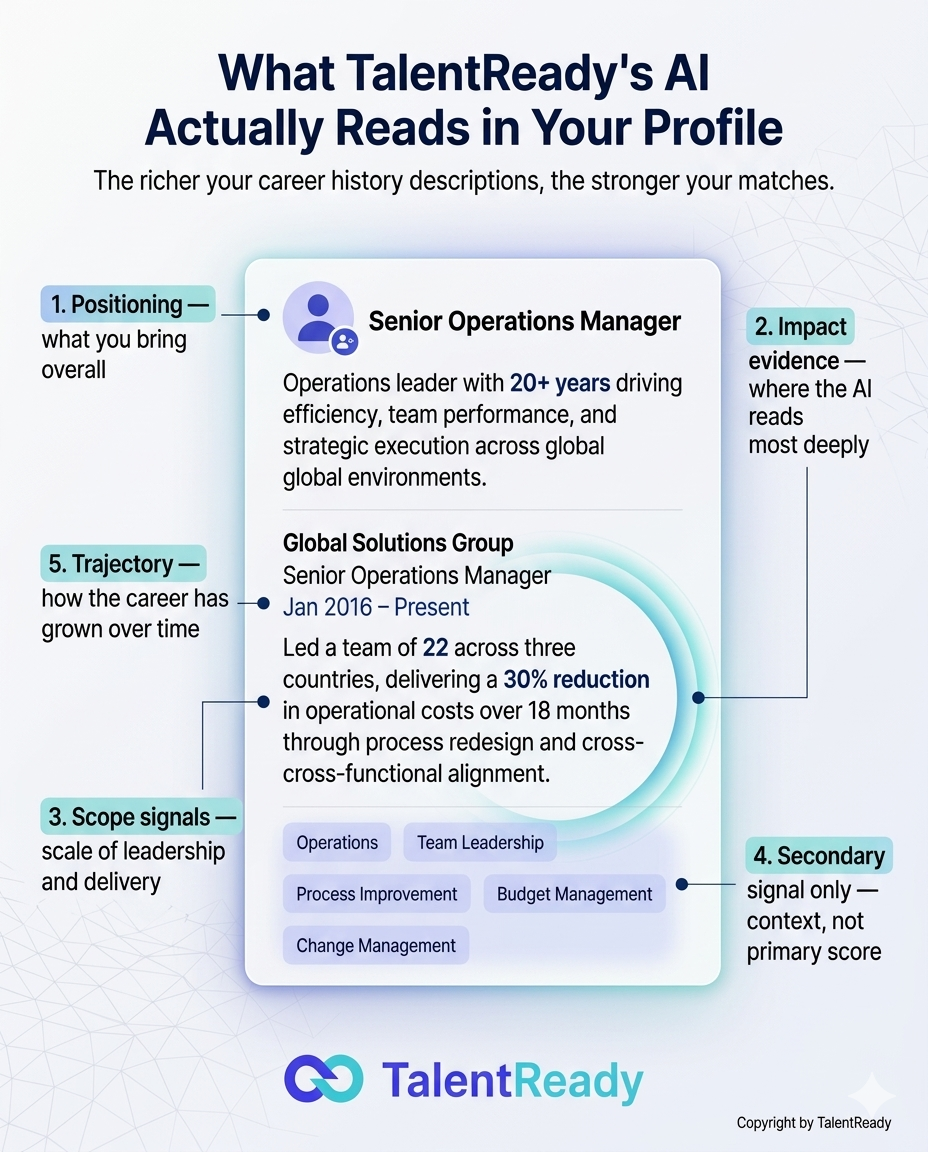
What TalentReady’s AI Actually Reads in Your Profile
Why This Matters in Singapore Right Now
Singapore’s MOM data shows thousands of PMETs are retrenched every year. Many are in their 40s and 50s, with deep expertise, strong track records, and real leadership experience.
The challenge is not capability. The challenge is visibility.
Standard job platforms run on keyword-matching algorithms designed for a different kind of hiring. Those algorithms are not neutral — they systematically disadvantage experienced professionals by design, even when that design was never intended to discriminate by age.
The Singapore government’s Fair Consideration Framework (FCF) requires employers to give fair consideration to Singaporeans and PRs before hiring foreign talent. That framework creates a structural opportunity for experienced local PMETs. But it only helps if employers can actually find those professionals.
That is the gap TalentReady is built to close. Not just by existing as another platform, but by matching differently — holistically, with bias correction built in, and with an AI designed to surface the value that keyword systems miss.
Building a Profile That Works With Holistic Matching
The practical implication of holistic matching is simple: your career history descriptions are the most important part of your TalentReady profile.
A few specific practices that make a difference:
Write outcomes, not duties.
“Managed supply chain operations” tells the AI you had the role. “Restructured supplier relationships across 12 vendors, reducing procurement costs by 18% while cutting lead times by 25%” tells the AI what you delivered.
Name the scale explicitly.
“Led a team” gives the AI a signal. “Built and led a cross-functional team of 35 across Singapore, Malaysia, and Indonesia, managing a $4.5M annual operating budget” gives it the evidence it needs to assess your leadership scope.
Include transitions deliberately.
If you’ve pivoted industries or functions, name the connection. Don’t assume the AI will infer what you are offering. “Moved from manufacturing operations into supply chain consulting, applying 15 years of operational due diligence experience” makes the transfer legible.
TalentReady’s AI polish tool is available in-profile to help you refine each section — it surfaces where your descriptions are underpowered and suggests specific improvements based on the role types you are targeting.
A Different Kind of Visibility
If you have been sending out applications and getting little response, the problem may not be your experience. It may be the matching system those applications are going through.
TalentReady connects mid-career professionals with ACRA-verified Singapore employers who are specifically looking for experienced candidates — not fresh graduates, not early-career professionals, but professionals with the depth and judgment that come from decades of work.
Many of these positions are not publicly advertised. Employers search the platform directly by skills, industry experience, and availability. The matching is done holistically — which means your full career picture, not just your keyword count, determines whether you appear.
Create your TalentReady profile — https://talentready.sg
It takes about 15 minutes. The AI polish tool helps you sharpen each section. And the platform is free for professionals to join and use.
Frequently Asked Questions
Does holistic matching mean TalentReady ignores keywords entirely?
No. Keywords still matter — they provide useful signal. What holistic matching changes is the weight and context. A keyword match is a starting point, not a final score. The AI goes deeper, evaluating the career history descriptions for evidence of what that keyword actually represents in practice. “P&L management” as a tag and “responsible for a $12M departmental budget with full ownership of variance reporting” as a description are not the same thing, and the AI treats them differently.
My career spans several industries. Will that hurt my matches?
The opposite. TalentReady’s matching is specifically designed to evaluate cross-industry capability rather than penalising it. If you have held leadership, operations, or strategic roles across sectors, the AI is looking for the underlying competencies — not just whether your last industry label matches the employer’s.
I have been out of work for several months. Does that affect how I am matched?
Gaps are visible in a profile, but they are not the primary signal the matching AI uses. Your 20-year career history carries more weight than a 6-month gap. What matters most is how you describe your experience during the period you were working. If you have been doing anything during the gap — courses, consulting, volunteer work — add it to your profile. It shows forward momentum.
How is TalentReady different from MyCareersFuture or LinkedIn?
MyCareersFuture and LinkedIn both use keyword-based matching and are designed for a broad professional audience that skews early-career. TalentReady is built exclusively for mid-career PMETs in Singapore, with an AI matching system specifically designed for experienced professionals and an employer base of ACRA-verified Singapore companies actively looking for that profile. Many positions on TalentReady are not listed on general job boards.
What does “ACRA-verified employer” mean?
Every employer on TalentReady is verified against the ACRA (Accounting and Corporate Regulatory Authority) register as a legitimate Singapore-registered company. This means the roles on the platform are real, the companies are real, and the people you are potentially engaging with have been screened — not just anyone who creates an account.
TalentReady is built specifically for experienced professionals in Singapore. Your career is the full picture — not a list of keywords. Build your profile today and let the matching work the way it should — https://talentready.sg