The Loyalty Tax: Why Staying Costs You More in Singapore
A viral post asked why new hires get 20%+ raises while loyal staff get 2–4%. Singapore's own 2025 wage data confirms the gap — and shows why "just job-hop" isn't the full answer after 40.
The Loyalty Tax: Why Staying Costs You More in Singapore
Singapore's own wage data —and why "just job-hop" isn't the whole answer after 40
A Singaporean's question went semi-viral this week: why do companies offer new hires more than 20% to walk in the door, while the people who stayed get 2% to 4% a year (The Independent Singapore, 2026)? The comments split into two camps —"just job-hop then" and "this is just how HR budgets work." Singapore's own wage data says both are right, and neither is the full answer.
The gap, in Singapore's own numbers
In 2025, nominal wages across Singapore grew 4.9% on average —a step down from 5.6% in 2024. But that average hides a split: only 72.4% of firms granted any wage increase at all that year. Among the firms that did give a raise, the average increment was 5.8% (Ministry of Manpower Singapore, 2026).
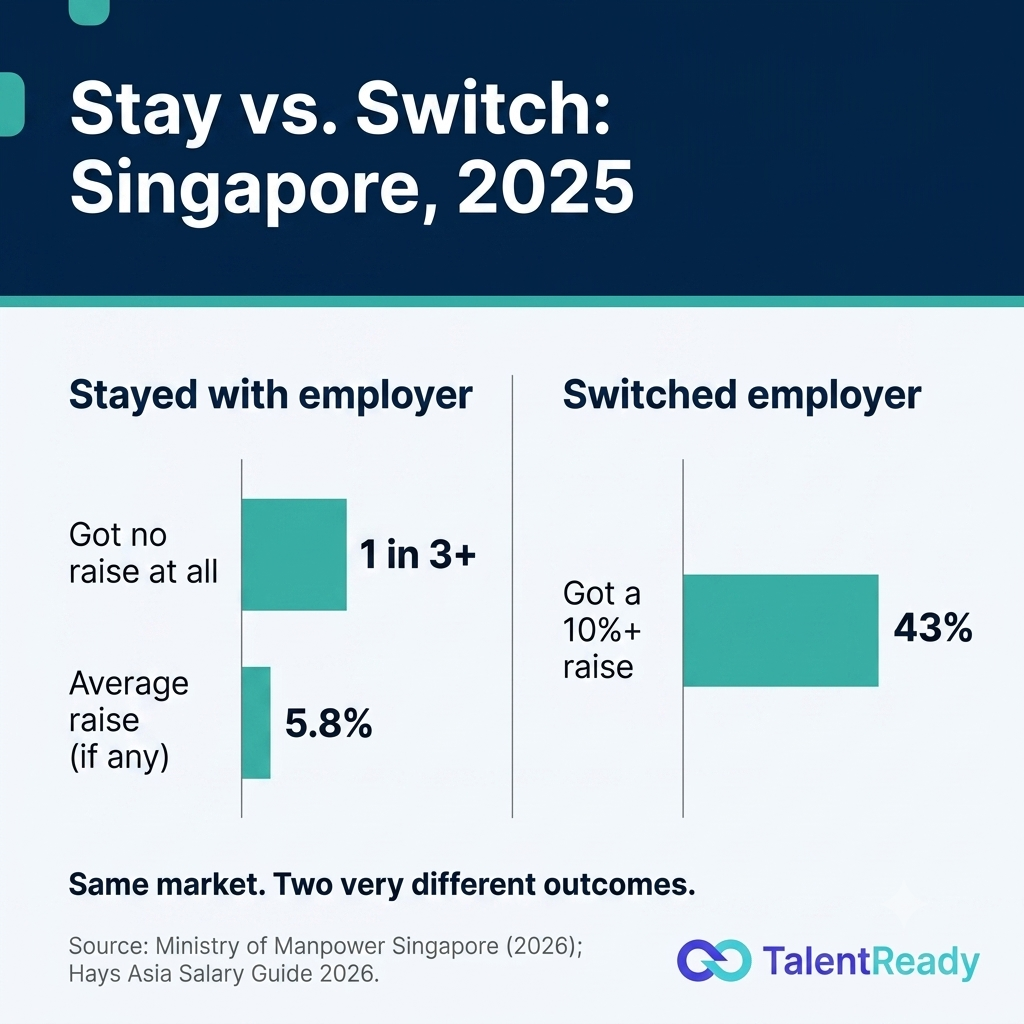
Now compare that to what movers got. Hays' 2026 Asia Salary Guide found 43% of Singapore professionals who switched employers in 2025 landed a pay rise of more than 10% —while more than a third of the people who stayed in their roles received no raise at all that year (Hays, 2026, as reported in People Matters, 2026, and Staffing Industry Analysts, 2026).
Put the two numbers side by side and the viral post's math checks out. Staying loyal in 2025 had roughly even odds of a below-6% bump or nothing. Leaving had close to even odds of a double-digit one.
Why this isn't a scandal —it's a budget
One commenter on the original post put it plainly: "Internal HR policies and budgets dictate how much increments can be handed out" (The Independent Singapore, 2026). That's the mechanism, and it's worth naming directly. Employee retention is the single most commonly cited reason Singapore firms give for raising wages at all —ahead of market benchmarking or cost of living (Ministry of Manpower Singapore, 2026). But the retention raise still comes out of a fixed internal pool, sized as a percentage of existing payroll. An external hire is priced against whatever the market demands right now, for that specific role, today. The two numbers are never calculated the same way —which is exactly why they never land the same.
This isn't unique to Singapore, and it isn't new. It's the mechanical result of how two separate budgets get set. But knowing the mechanism doesn't make the gap smaller for the person living inside it.
Why "just job-hop" isn't the full answer after 40
The advice in half the comment section —move every few years, chase the market rate —is directionally correct and incomplete for anyone past their late 30s. Jobseekers aged 50 and above report facing age discrimination in Singapore's job market at more than three times the rate of those under 50 —37.9% versus 12.2% (Ministry of Manpower Singapore, 2024), a gap we unpack further in a companion piece on Singapore's salary ceiling. The switcher premium above is real, but it isn't evenly available. It disproportionately goes to whoever gets through the funnel to an offer in the first place.
For a 25-year-old, "just apply more" is a workable strategy. For a mid-career professional, the bottleneck usually isn't willingness to move —it's getting a real, competitive offer in front of you before an ATS (Applicant Tracking System —specialized recruitment software that automates and manages the entire hiring process) filter or an unconscious age screen removes you from the pile.
Where TalentReady fits
This is the specific gap TalentReady's AI matching is built to close —it reads career depth and demonstrated impact, not just a title or a graduation year, so a 20-year track record counts for what it actually is. Every job you browse already carries a match score against your real profile, and the same profile works passively too: employers set a minimum match threshold, and if you clear it, you can be surfaced to them directly —which is how a market-rate offer reaches you without needing to out-apply an algorithm built for someone else's resume.
Think of it as a headhunter that never runs out of hours in the day: a human recruiter can only actively track a handful of senior candidates at once, but TalentReady's matching keeps your profile in front of every employer whose bar you clear, continuously. (More on why that matters most for senior, niche roles —where the market is thinnest —in the next piece.)
Before that conversation starts, it helps to know where your pay sits today. TalentReady's free Salary Check (talentready.sg/salary-check) shows the low, middle and high pay for your exact job title, using the same MOM data behind the numbers above — no sign-up needed.
One thing to do this week
Pull up your last increment letter and do the math as a percentage, not a dollar figure. If it's below 5.8% —the average among firms that gave a raise at all in 2025 —you now have a specific, sourced number to bring into a conversation, whether that conversation is with your current manager or a prospective one. "I'm below the national average for firms that raised pay this year" is a harder sentence to wave away than "I feel underpaid."
Then run your title through the Salary Check tool. If the P75 for your role is meaningfully above what you're earning now, that's not a feeling either —that's a number you can act on.
TalentReady is Singapore's AI job matching platform built for mid-career professionals. Sign up free at talentready.sg.
References
Hays. (2026). Asia salary guide 2026: Singapore edition. hays.com.sg (as reported in People Matters, 2026, and Staffing Industry Analysts, 2026)
Ministry of Manpower Singapore. (2024). Fair employment practices report 2023. mom.gov.sg
Ministry of Manpower Singapore. (2026). Report on wage practices 2025. mom.gov.sg
The Independent Singapore. (2026, July 13). Singaporean asks why companies pay new hires 20% more while loyal employees get 2 to 4% raises. theindependent.sg
Note. The Hays (2026) figures are cited via secondary reporting (People Matters; Staffing Industry Analysts) as the primary Hays report was not directly accessible at time of writing —treated as directional, consistent with other Singapore salary-guide data in this series. The MOM 5.8% average increment applies only to the 72.4% of firms that granted any increase in 2025, not to all firms surveyed.