Resume Tips for Retrenchment Survivors in Singapore: How to Present Your Story and Get Hired
Thousands of Singapore PMETs are retrenched every year. What separates those who bounce back quickly is not luck — it is how they tell their story on paper. Eight practical moves that work.

Resume Tips for Retrenchment Survivors in Singapore: How to Present Your Story and Get Hired
Retrenchment is more common in Singapore than most people talk about. According to MOM data, thousands of PMETs (Professionals, Managers, Executives and Technicians) are retrenched every year — and that number spikes sharply during economic slowdowns and industry restructuring.
If you have been retrenched, here is the first thing to know: it is not a character flaw. It is a data point. What matters far more to employers is how you present the 15, 20, or 25 years of experience that came before it.
The second thing to know: your resume is where that story gets told. Get it right, and a retrenchment becomes a non-issue. Get it wrong, and it becomes the headline — even when it should not be.
This guide is written specifically for mid-career professionals in Singapore navigating this moment. We will walk through the practical choices that make the difference.
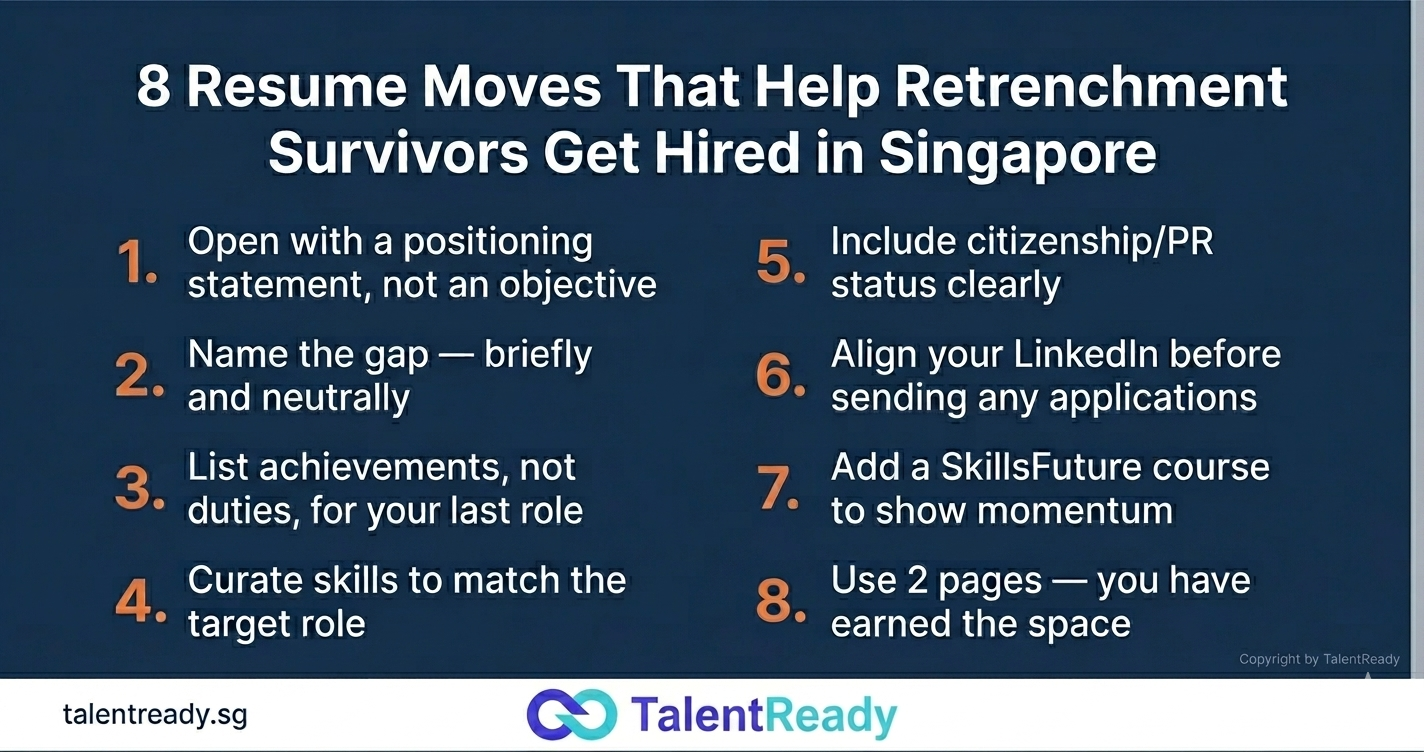
8 Resume Moves That Help Retrenchment Survivors Get Hired
Why Retrenchment Resumes Are Different
A fresh graduate’s resume is about potential. A mid-career resume after retrenchment is about two things simultaneously: your body of work and your forward narrative.
Employers looking at someone with 15+ years of experience are not just asking “can they do the job?” They are asking “why are they available, and do they know where they are going?” Your resume needs to answer both questions before the interviewer even picks up the phone.
The mistake most professionals make is letting the retrenchment dominate the story by either:
• Leaving a conspicuous gap with no explanation
• Over-explaining the layoff with defensive language
• Underselling decades of achievement to appear “humble” or “flexible”
None of these serve you. Here is what does.
1. Lead With Your Value, Not Your Timeline
The top third of your resume should answer one question: what do you bring?
Open with a professional summary of 3–4 sentences. This is not an objective statement (“I am seeking a role where I can...”). It is a positioning statement — a concise argument for why you are the right person.
Example for a finance professional:
Senior Finance Leader with 18 years driving P&L performance across Singapore and Southeast Asia. Deep expertise in FP&A, treasury operations, and cross-border compliance. Known for building high-trust relationships with C-suite stakeholders and delivering 15–30% cost efficiencies through process transformation. Currently available for immediate engagement.
Notice what is not in that summary: the word “retrenched,” the name of the previous employer, or any hint of desperation. What is there: specificity, evidence, and forward energy.
2. Address the Gap — Briefly and Confidently
If your last role ended several months ago, the gap will be visible. Do not hide it; do not dramatise it.
The cleanest approach is a single line in your work history:
Career Transition Period | [Month Year – Present]
Pursuing professional development and evaluating next career opportunity following company-wide restructuring.
This does three things: it names the gap, explains it neutrally, and signals intentionality. Bonus: if you have done anything during this period — SkillsFuture courses, volunteer work, consulting — list it here. It shows forward momentum.
3. Reframe Your Most Recent Role
The natural instinct after retrenchment is to downplay your last employer because the association feels negative. Resist this.
Your last role is still part of your track record. Write it the same way you would write any other role: with specific, quantified achievements.
Weak:
Managed a team and oversaw daily operations.
Strong:
Led a cross-functional team of 12 across Singapore and Malaysia; delivered a digital workflow transformation that reduced processing time by 40% and cut operational costs by SGD 280K annually.
The retrenchment happened to the company, not to your accomplishments. Your results are still real.
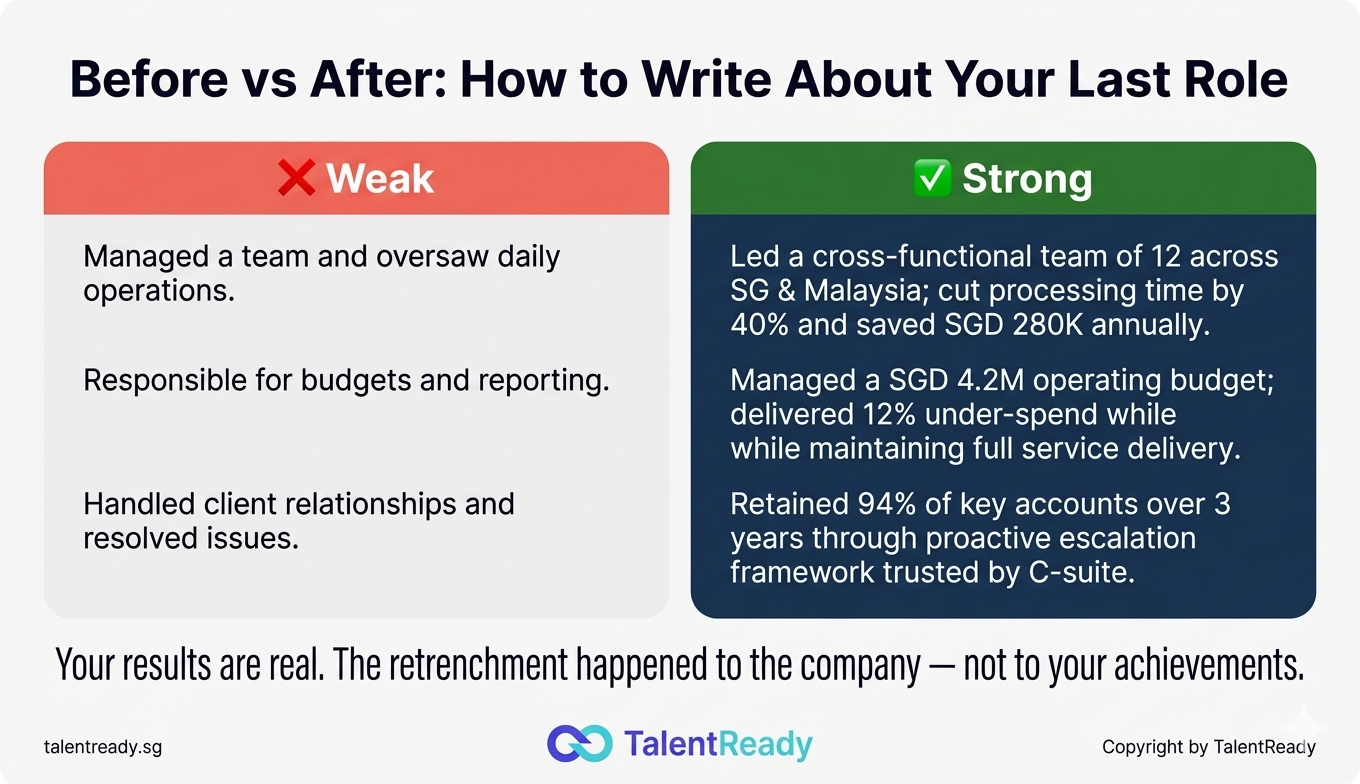
Before vs After: How to Write About Your Last Role
4. Make Skills Work for You, Not Against You
Mid-career professionals often have broad skill sets built across many years. The temptation is to list everything — to show range.
Do the opposite. Curate your skills list to match the role you are targeting. A 20-year career in supply chain logistics does not need to mention that you once managed a small marketing campaign. Keep it tight and relevant.
If you are pivoting slightly — for example, moving from an operations role into a consulting or advisory position — identify the transferable skills explicitly. Do not assume employers will make that connection themselves. Use language like:
Stakeholder management, operational due diligence, and cross-functional leadership — skills directly transferable to consulting and advisory engagements.
5. Use the Fair Consideration Framework to Your Advantage
Singapore’s Fair Consideration Framework (FCF) requires employers to consider Singaporeans and PRs fairly before hiring Employment Pass holders. As a Singaporean PMET, this framework is in your favour — but only if employers can find you.
This means your resume must be clear about your citizenship or PR status, and your skills must be searchable. AI-driven applicant tracking systems scan for keywords before a human ever sees your document. Use the exact job title and skill terms from the job description — do not paraphrase.
6. Update Your LinkedIn to Match
A hiring manager who likes your resume will immediately check your LinkedIn. If the two tell different stories — different dates, different scope, different tone — it creates doubt.
Align them before you send a single application. Your LinkedIn summary should echo your resume’s professional summary. Your most recent role’s end date should be visible (not hidden). And your headline should not read “Open to Work” as its only content — it should read like a professional positioning statement.
“Senior Finance Leader | FP&A | Treasury | Southeast Asia” is far more compelling than “Finance Professional | Currently Looking.”
7. Use Your SkillsFuture Credits Now
If you have not used your SkillsFuture credits, retrenchment is the moment to deploy them. Beyond the immediate upskilling value, a recent certification on your resume signals to employers that you have been active and forward-looking — not idle.
NTUC’s UTAP (Union Training Assistance Programme) also provides up to 50% funding for approved courses for union members. Combining SkillsFuture with UTAP can make high-value certifications nearly free.
Courses that tend to improve hiring outcomes for mid-career PMETs: data analytics fundamentals, project management certifications (PMP, CAPM), leadership coaching credentials, and industry-specific digital tools.
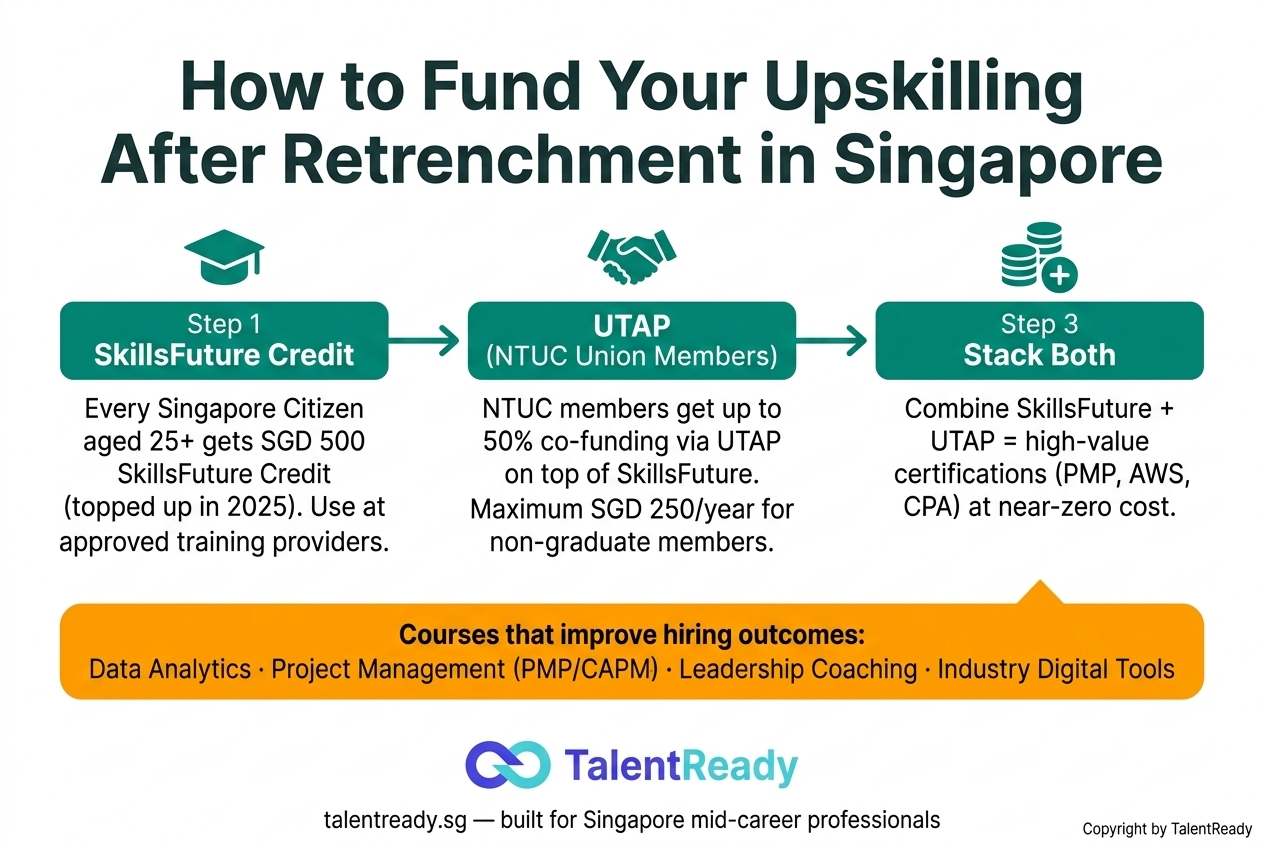
SkillsFuture + UTAP: Fund Your Upskilling After Retrenchment
8. The One-Page Rule Does Not Apply to You
Entry-level candidates are told to keep resumes to one page. Mid-career professionals with 15–25 years of experience are not entry-level candidates.
Two pages is appropriate. Three pages is acceptable if every line earns its place. The test is not length — it is relevance. Remove anything from more than 15 years ago that does not directly support the role you are targeting. Keep everything recent and achievement-focused.
Getting Your Resume Seen
Writing a strong resume is step one. Getting it in front of the right employers is step two.
TalentReady is built specifically for mid-career PMETs in Singapore. Your profile is matched to ACRA-verified employers who are actively looking for experienced professionals — not fresh graduates. Employers search by skills, industry experience, and availability. Many positions are not publicly advertised.
Create your TalentReady profile → https://talentready.sg
It takes about 15 minutes to complete, and our AI polish tool helps you refine each section so your profile reflects your best work.
Frequently Asked Questions
Should I mention retrenchment in my cover letter?
Only if asked, or if the gap is long enough to invite questions. Keep it to one sentence, factual and neutral: “I was part of a company-wide restructuring in [month/year] and have been focused on finding the right next opportunity since then.” Then pivot immediately to your value.
How long is too long a gap before employers become concerned?
In Singapore’s current market, most hiring managers understand gaps of up to 6–9 months, especially for senior roles. Beyond 9 months, adding a short note about active steps taken (courses, consulting, volunteering) helps maintain credibility.
Do I need to disclose my previous salary?
No. Singapore does not legally require salary disclosure on applications. You can state your expected range instead. Many employers now ask for expected salary rather than last drawn — answer that question, not one that was not asked.
What if my most recent company is known for mass layoffs?
The company’s reputation is not yours. Interviewers know that large-scale restructuring is a business decision, not a performance one. Your track record at that company — your results, your tenure, your scope — is what matters. Present those facts clearly.
Is it worth working with a recruiter?
For roles that are not publicly advertised, having your profile visible to employers who are actively searching is more effective than waiting for a recruiter to call. TalentReady is built specifically for this — ACRA-verified Singapore employers search the platform directly by skills, industry, and availability, and many of these opportunities never appear on job boards. If you also choose to register with an executive search firm, treat it as a parallel channel, not a replacement for owning your own visibility.
TalentReady connects experienced professionals with Singapore employers who value what you bring. Build your profile today → https://talentready.sg