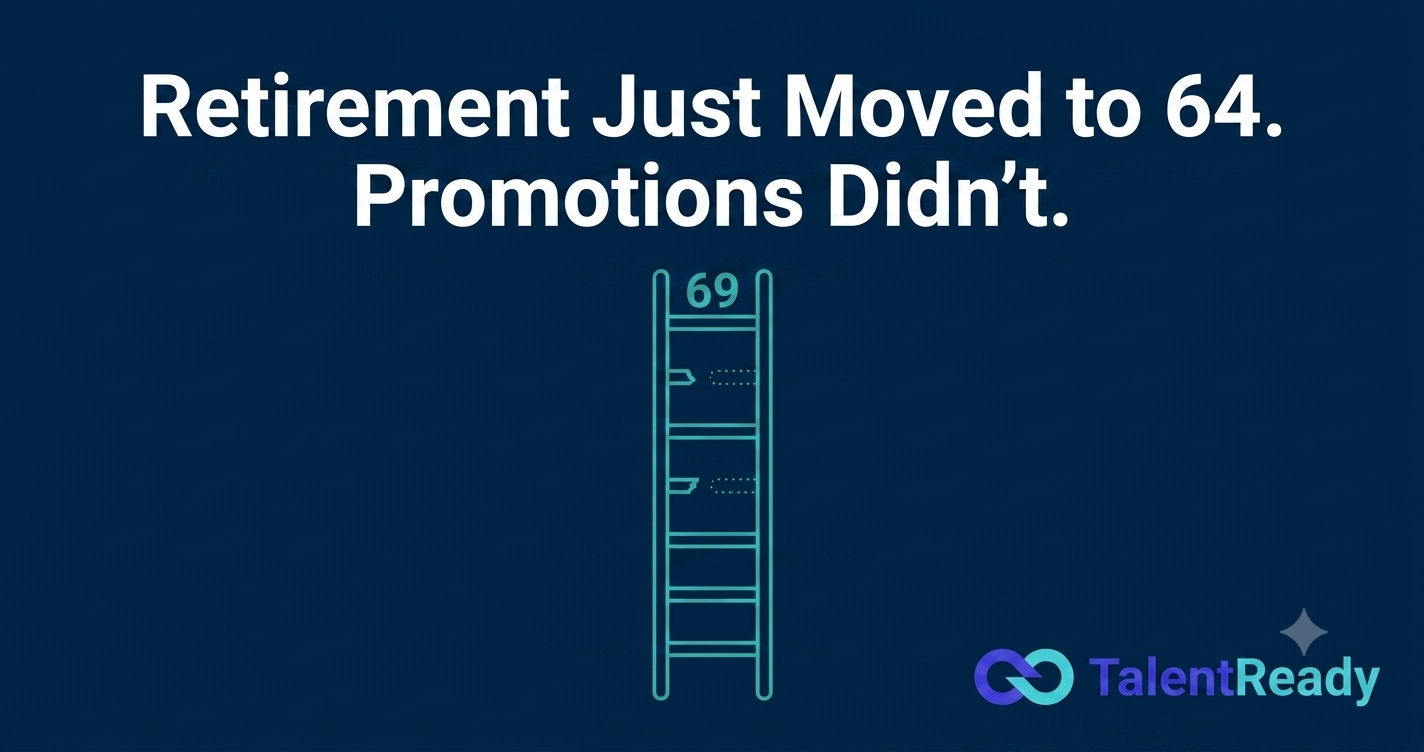
Retirement Just Moved to 64. Promotions Didn't.
Singapore's retirement age rises to 64 and re-employment to 69 on 1 July 2026 — good news if you're near the top of your career. For everyone still climbing, it's one of two forces pulling on the same rung at the same time. Here's the data on both, and the one thing worth checking before you wait any longer.
Retirement Just Moved to 64. Promotions Didn't.
On 1 July 2026, Singapore's retirement age moved from 63 to 64, and the re-employment age from 68 to 69 — the second scheduled step toward 65 and 70 by 2030, announced by Senior Minister of State for Manpower Dr Koh Poh Koon at MOM's Committee of Supply 2026. If you are close to that age, this is unambiguously good news: one more year of income, one more year of CPF contributions, one more year in a role you already hold.
If you are not close to that age — if you are the professional still climbing toward it, somewhere in your 30s or 40s — the same change lands differently. It does not put your job at risk. It changes the maths on what comes next, from two directions at once, not one.
Two headwinds, not one
The first is the one everyone can see. Employers must now offer eligible staff continued employment up to 69, not 68 — one more year at the top before those seats even become available to move into. This is not a rule employers quietly ignore: MOM's own figures show more than 90% of eligible seniors who seek re-employment successfully secure it, which means the mechanism is genuinely being used, at scale, to keep senior employees in place for longer.
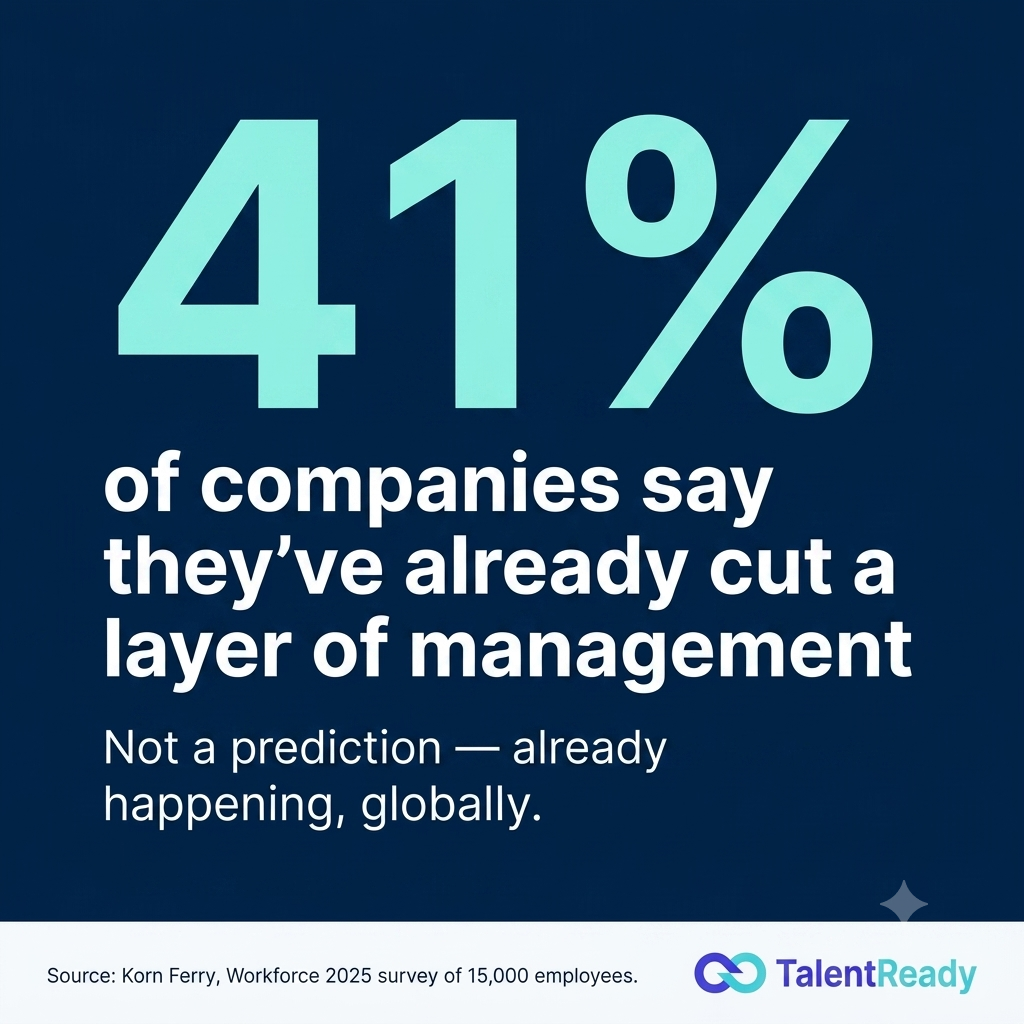
The second headwind is less visible, and it does not wait for a policy announcement to take effect. Gartner predicts that by 2026, one in five organisations will use AI to flatten their structure, cutting more than half of the middle-management roles inside them. It is not just a prediction anymore — Korn Ferry's Workforce 2025 survey of 15,000 employees worldwide found 41% already report their company has cut a layer of management, and separate workforce data (Live Data Technologies, as reported by The Wall Street Journal) puts US manager headcount down 6.1% and executive-level roles down 4.6% between May 2022 and May 2025. Gallup's own numbers show the average manager went from 10.9 direct reports in 2024 to 12.1 in 2025 — up from just 8.2 in 2013 — which is what a flattening structure looks like from the inside: fewer managers, each covering more people.
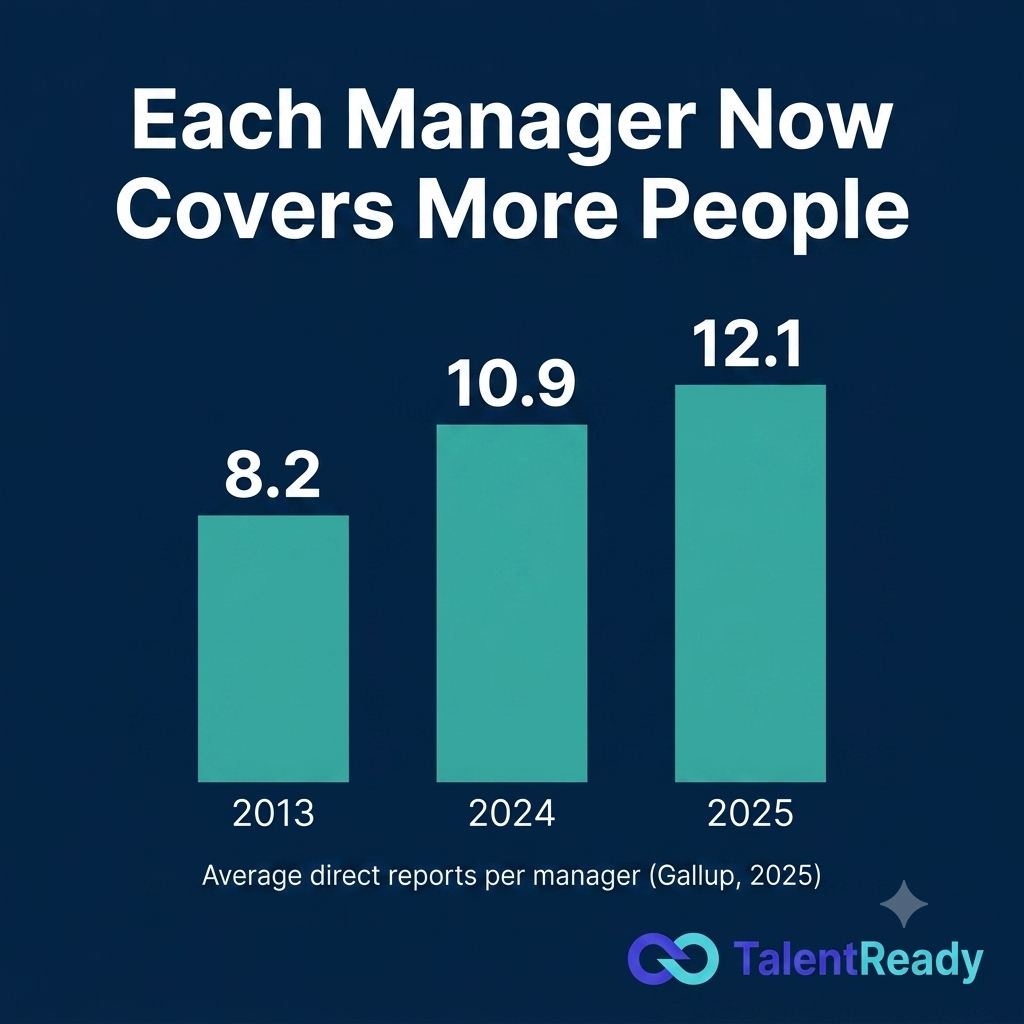
Put plainly: the people above you are being asked to stay one year longer, and the layer you'd normally be promoted into is getting thinner at the same time. Neither of these is a Singapore-specific study — but the retirement change is, and it is not a small one.
If the shape of your ladder right now is "wait longer, for fewer open seats, inside a flatter structure," the more useful question isn't when the next promotion is coming.
The honest catch
No one is tracking a direct line from "the senior person stayed until 69" to "you didn't get promoted this year" — that causal chain is not something any dataset actually measures, and re-employment does not guarantee someone keeps the exact same role at the exact same scope. Treat the connection here as a reasonable reading of two real, converging trends, not a proven mechanism.
There is a second honest catch, and it cuts the other way. The same cuts squeezing middle management now are creating a leadership shortage later: Korn Ferry found 72% of senior executives already feel the strain of running flatter teams, and DDI's 2025 Global Leadership Forecast, drawn from over 10,000 leaders across 50 countries, puts leadership bench strength at just 20%. Fewer people are being developed into the next layer of leadership — which is a shortage in the making, not a solved problem. That is not much comfort if you are the one waiting right now, but it is a reason demonstrated, real-world scope of experience is likely to matter more once the current squeeze eases, not less.
What this changes for you
We've made a version of this argument before, about a different variable: Singapore's own job-mobility data says the age you switch jobs at matters less than most professionals assume — what matters is whether the move itself is a good fit (Career Switch at 32, Not 45). The same logic applies here. If the internal path up is genuinely slower now, on both ends, that isn't a reason to panic. It's a reason to stop treating "wait for the next promotion" as the only path, and start treating "know what my experience is worth right now" as the more reliable one — because that number doesn't depend on anyone above you retiring, or on your org chart staying the shape it is today.
Sign up free at talentready.sg.
The retirement age moving is not the story. What it does to the rungs underneath it is.
TalentReady is Singapore's AI job matching platform built for mid-career professionals. Sign up free at talentready.sg.
References
Ministry of Manpower Singapore. (2026, March 3). Committee of Supply 2026: Retirement and re-employment ages to be raised to 64 and 69 from 1 July 2026 [Speech by Dr Koh Poh Koon, Senior Minister of State for Manpower]. As reported by Human Resources Online.
Allen & Gledhill. (2026, March). Retirement and re-employment ages to be raised to 64 and 69 from 1 July 2026. allenandgledhill.com
Gartner, Inc. (2024, October 22). Gartner Unveils Top Predictions for IT Organizations and Users in 2025 and Beyond. gartner.com. As reported by Forbes (2026, June 30).
Korn Ferry. (2025). Workforce 2025: Power Shifts [global survey of 15,000 employees]. kornferry.com
Live Data Technologies, as reported by The Wall Street Journal and Forbes (2026, June 30). Management Cuts Today Are Shaping A Leadership Shortage.
Gallup. (2025). Manager span-of-control data. As reported by Forbes (2026, June 30).
Development Dimensions International (DDI). (2025). Global Leadership Forecast 2025 [10,000+ leaders, 50 countries]. As reported by Forbes (2026, June 30).
Note. The retirement/re-employment age change and the >90% re-employment take-up figure are drawn directly from Singapore government sources (MOM's Committee of Supply 2026 speech and law-firm client alerts summarising it), current as of the 3 March 2026 announcement and 1 July 2026 effective date. The Gartner prediction, Korn Ferry survey, Live Data Technologies figures, Gallup span-of-control data, and DDI Global Leadership Forecast are global, not Singapore-specific, and several were accessed via Forbes' aggregation of them rather than each original report directly (the Gartner press release blocked direct access) — all figures were cross-checked against at least one independent source citing the same original study before use. The link between Singapore's re-employment change and middle-management compression is presented as a reasonable reading of two converging trends, not a proven causal claim — no dataset directly measures that connection.