What Is a Manufacturing Manager Actually Worth in Singapore?
MOM publishes real wage data for every occupation in Singapore. Here's how to read the P25/P50/P75 range for a Manufacturing Manager — and use it in your next salary conversation.
What Is a Manufacturing Manager Actually Worth in Singapore?
How to Read the Numbers and Use Them
Singapore's manufacturing sector is in the middle of a transition few people outside it are talking about —Industry 4.0, automation, and advanced manufacturing hubs are reshaping what "manufacturing manager" even means. Demand for experienced plant and production leadership is rising. But most manufacturing managers still walk into a salary conversation the same way everyone else does: with a gut feeling instead of a number.
You have been offered $8,000 a month to run a production line or plant. Is that fair?
Most mid-career manufacturing professionals cannot answer that with confidence. They compare it to their last salary, benchmark against a former colleague, or accept because the number sounds reasonable for the industry. None of those methods are reliable —and in a sector where headcount responsibility, safety accountability and output targets scale fast with seniority, the cost of underpricing yourself compounds for years.
Singapore's Ministry of Manpower publishes the real answer: actual wage data, by occupation, drawn from what people are really paid —not what a job ad advertises. TalentReady turns that data into a benchmark shown directly on your dashboard, so you are not left digging through government statistics alone. This article explains how to read the numbers —and how to use them in a real salary conversation.
The three numbers: P25, P50, and P75
MOM's Occupational Wage data breaks salaries into three percentiles for every occupation:
P25 —25% of people in this role earn below this figure.
P50 (median) —half earn below, half earn above. The true market midpoint, not skewed by outliers the way an average is.
P75 —25% of people in this role earn above this figure —roughly the top quarter of the market.
Together, they give you a range, not a single number —so you can place any offer in context.
A concrete example: Manufacturing Manager
Based on MOM's Resident Occupational Wages, June 2024, a Manufacturing Manager in Singapore sits roughly in this range (gross monthly wage, including employer CPF):
P25 ~$6,126/month
P50 ~$8,571/month (market midpoint)
P75 ~$11,110/month
Source: Ministry of Manpower Singapore, Resident Occupational Wages, June 2024 (via data.gov.sg). Figures are approximate —verify against the latest edition at mom.gov.sg/statistics.
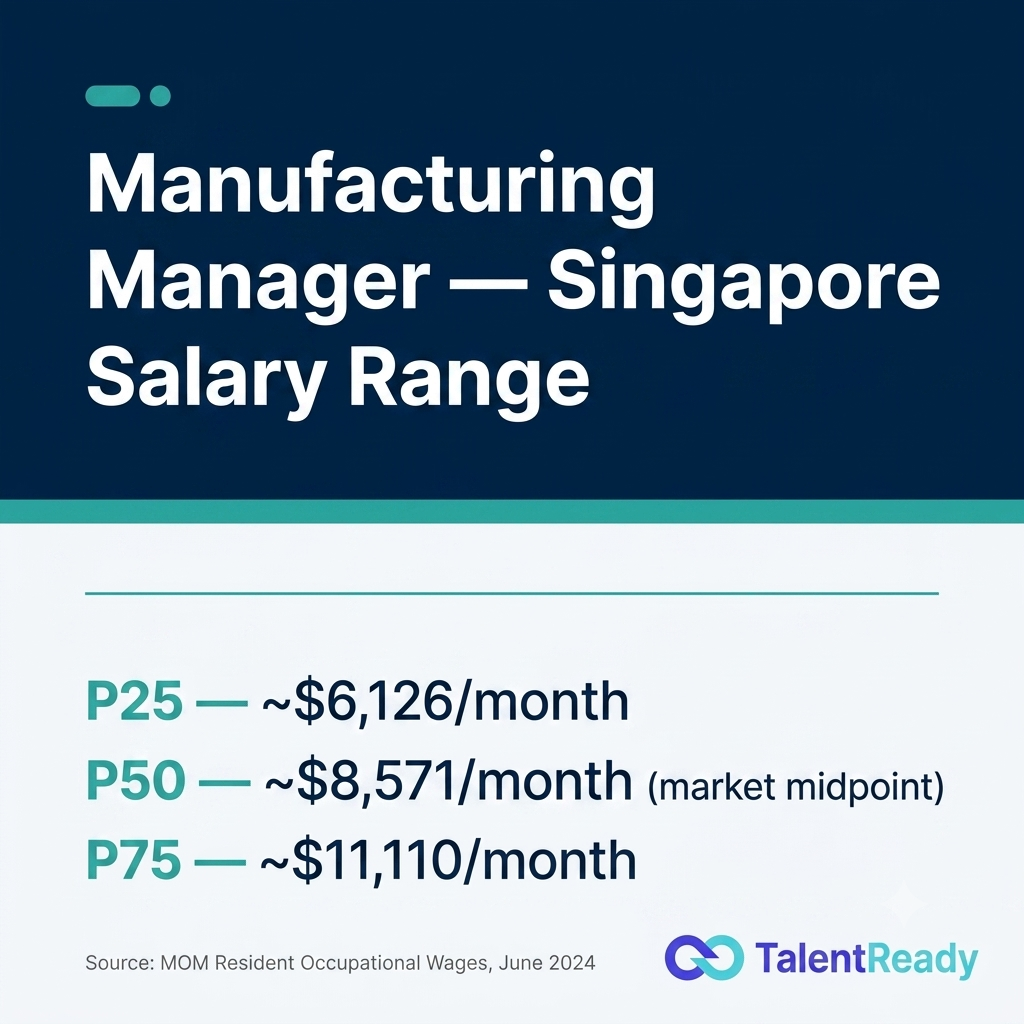
This spread is significant. An offer of $6,500 sits near the bottom of the market. An offer of $9,500 is comfortably above median but not yet top quartile. Neither number means anything on its own —only against the range.
For comparison, two adjacent manufacturing roles show how fast the range moves with scope: a Manufacturing Engineer sits at roughly P25 $2,596 / P50 $4,589 / P75 $6,860, while a Quality Control/Assurance Manager sits at roughly P25 $6,174 / P50 $9,100 / P75 $14,094. The jump from engineer to manager is not incremental —it reflects a real step up in accountability, and the market prices it that way.
Why manufacturing professionals often get this wrong
Anchoring to the last salary. If you earned $7,800 in your previous plant and a new offer comes in at $8,200, it feels like a raise. It may still be below P50 for the role you are stepping into. Your last salary is not a market data point —it is what one employer paid you, on one production line, in a different cost structure.
Undervaluing cross-functional scope. Manufacturing managers who have carried safety compliance, cross-shift headcount, vendor negotiation and output targets simultaneously are doing work that spans several separate job titles elsewhere. That combined scope rarely gets priced in unless you name it explicitly during negotiation.
Fear of losing the offer. After a retrenchment, a plant closure, or an extended search, the instinct is to accept before the offer disappears. This is understandable. It is also the single most expensive financial decision most people make during a job search. Employers expect negotiation —particularly at the senior level.
Relying on advertised job ranges. Job-listing salary tools are genuinely useful for calibrating early-career offers, where the posted range often is the negotiation range. At the senior manufacturing level this breaks down. Plant and production leadership roles are frequently filled through direct outreach or referral and are rarely advertised at all, and the range on a listing is often the floor a company is willing to offer, not the ceiling a strong candidate can command. A number scraped from a job ad tells you what was advertised. It does not tell you what was actually paid.
How to use this data in a real conversation
Once you know your P50 and P75, the conversation becomes straightforward.
If the offer is below P50:
"I have looked at MOM's occupational wage data for this role. The median for a Manufacturing Manager in Singapore is around $8,571. Based on my [X years running production lines / specific safety or output track record], I was expecting to be at or above that. Is there flexibility to get closer to $8,500?"
If the offer is between P50 and P75:
"The offer is fair relative to the market median. Given my [specific scope —headcount managed, output volume, safety record, automation rollout led], I would like to explore whether there is room to move to [P75-adjacent figure]. Is that a conversation worth having?"
Two rules for this conversation: cite the source (MOM, not “I heard” or “I think”), and anchor to your specific scope —not just tenure. Years on the floor is a weak negotiating variable. Headcount managed, output delivered, safety record, and any automation or process improvement you led —those are strong ones.
Finding your number
MOM's occupational wage data covers over 500 occupations and is updated annually. Unlike tools built on job listings, this dataset reflects wages actually paid across the workforce —drawn from employer wage surveys, not job ad copy written to attract applicants. You can find the current release at mom.gov.sg/statistics under "Occupational Wages."
The challenge is that MOM's data uses standardised occupational categories, which may not map cleanly to your actual job title. A "Senior Plant Manager" or "Operations Manager (Manufacturing)" might sit across two or three different MOM categories depending on how the company defines the role —Manufacturing Manager, Production Engineer, or Quality Control/Assurance Manager can each be the closer match.
The TalentReady salary benchmarking tool solves this: it maps your profile and target role against live Singapore market data and shows your P25/P50/P75 range directly on your dashboard. No manual cross-referencing needed.
If you are a professional on TalentReady, your salary benchmark is already calculated —look for the salary range indicator on your profile page.
If you are not yet on the platform, you can sign up free at talentready.sg and see your benchmark within minutes of completing your profile.
The number is not the ceiling
Knowing your P50 tells you where the market sits. It does not tell you where you should sit. For mid-career manufacturing professionals with genuine depth —multi-shift leadership, safety accountability, automation rollout experience, the ability to walk onto a floor and stabilise output from week one —the P75 is often the more honest benchmark.
The question worth asking before any salary conversation is not "what will they accept?" It is: "what is a senior hire with my track record actually worth to this plant?"
Answer that first. Then negotiate from there.
TalentReady is Singapore's AI job matching platform built for mid-career professionals. Sign up free at talentready.sg.
References
Ministry of Manpower Singapore. (2024). Resident Occupational Wages, June 2024. Retrieved via data.gov.sg.
Ministry of Manpower Singapore. (n.d.). Occupational Wages —Source and Coverage. stats.mom.gov.sg
Ministry of Manpower Singapore. (n.d.). Fair Consideration Framework. mom.gov.sg/employment-practices/fair-and-progressive-practices
Note. Salary percentiles for the Manufacturing Manager, Manufacturing Engineer, and Quality Control/Assurance Manager examples are drawn from MOM's Resident Occupational Wages, June 2024 dataset (data.gov.sg, resource ID d_9917e751f7498502f70052a940a3f312). Readers are advised to verify figures against the latest available edition, published annually.