Career Switch at 32, Not 45
MOM's own job-mobility data says the age band with the best odds of a good outcome after switching jobs isn't the one most professionals would guess. Here's what the numbers actually show — including the honest catch — and why the age was never the real variable.
Career Switch at 32, Not 45
MOM's own job-mobility numbers point to one age band as the strongest time to switch — not the one most professionals assume, and with one honest catch worth knowing before you do.
If you're 32 and weighing a switch, you've probably already heard the pushback: you haven't even planted your career yet — why uproot it now? It sounds like caution. Singapore's own labour data says close to the opposite. Look at who actually switches jobs and what happens to them afterward, and your early thirties aren't the risky age to gamble on. They're the age band with the best odds in the entire workforce.
The best odds aren't where you'd guess
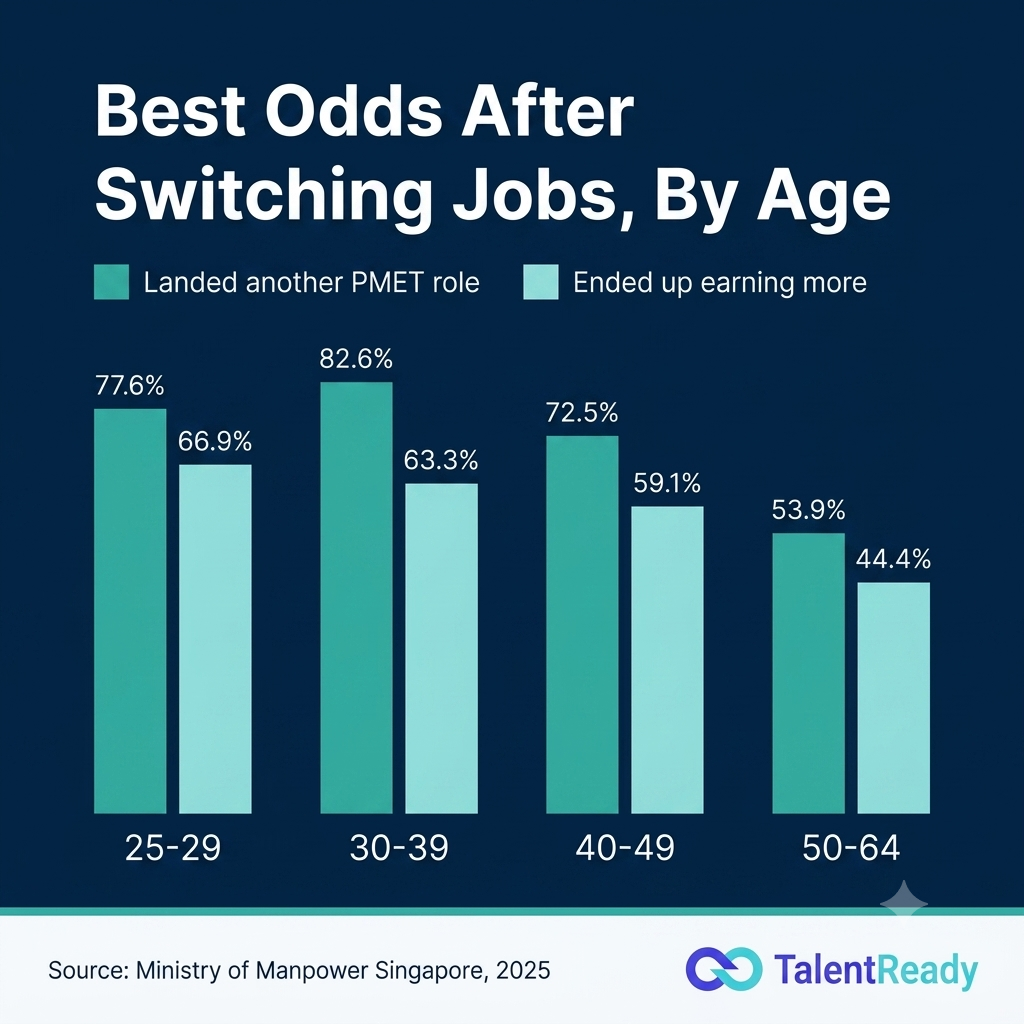
The Ministry of Manpower tracks what happens to full-time resident employees after they change jobs — whether they land another PMET role, and whether they end up earning more, the same, or less. The 2025 figures split cleanly by age, and the 30–39 band — not 25–29, not 40–49 — comes out on top on the metric that matters most for a switch: whether you land somewhere better.
82.6% of resident employees aged 30 to 39 who switched jobs landed another PMET role — the highest of any age band, ahead of even 25–29-year-olds at 77.6%. On income, 63.3% of 30–39 switchers came out ahead, close behind the 25–29 band's 66.9% and clearly ahead of 40–49 (59.1%) and 50–64 (44.4%), where both the PMET-landing rate and the income-uplift rate drop off sharply (Ministry of Manpower Singapore, 2026).
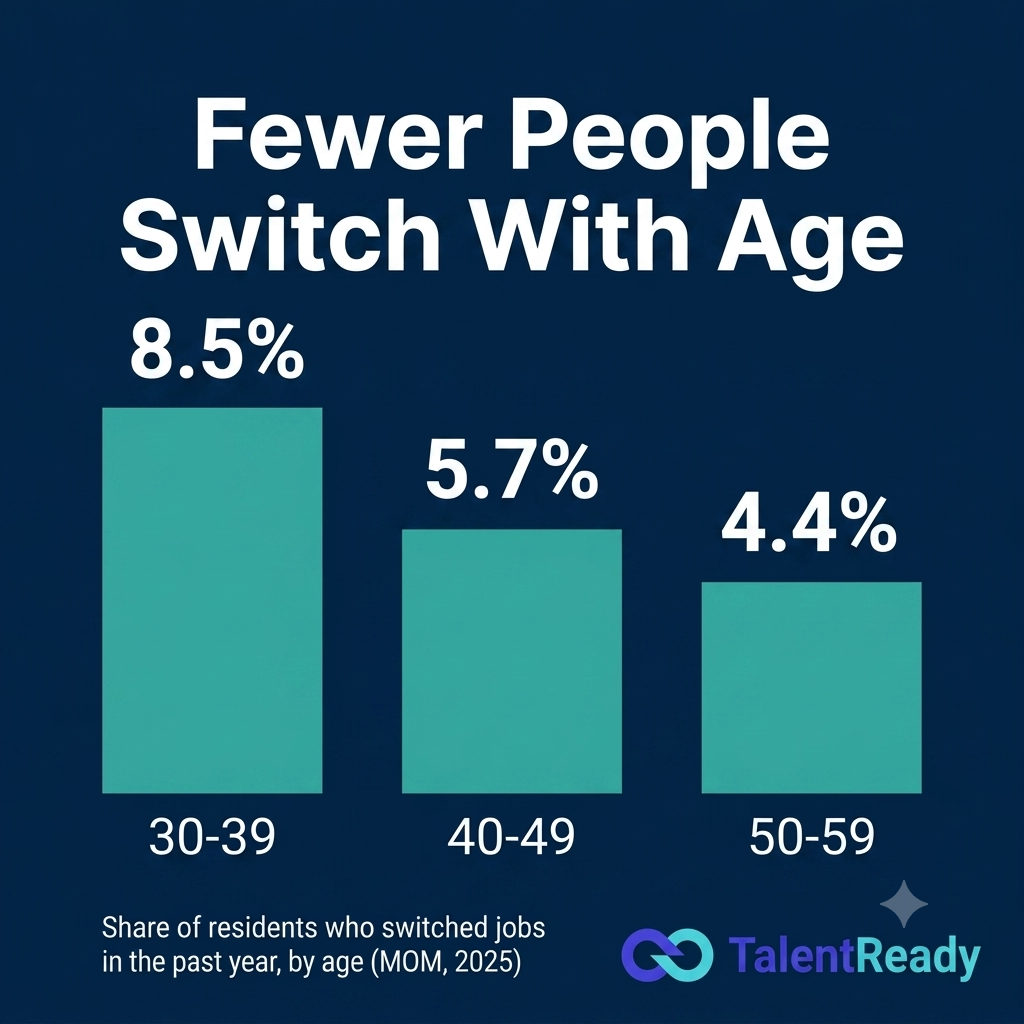
What makes this more striking is that fewer people in their thirties are even doing it. The share of residents switching jobs in a given year falls steadily with age — 8.5% at 30–39, down to 5.7% at 40–49 and 4.4% at 50–59 (Ministry of Manpower Singapore, 2026). Most professionals in their thirties who could get the best outcome on record aren't switching at all. The "plant your career first" instinct isn't irrational — it's just aimed at the wrong age band.
One clarification worth stating plainly: this is switching — changing employer or role — not pivoting into a different field entirely. MOM's data doesn't separately track people who stayed in their lane versus those who changed industry. The odds above are for anyone in their thirties who made a move: same-field or a genuine pivot both count. If your switch is also a pivot, the reasoning for why still holds — you're carrying transferable skills into a new setting while you have the most working years left to recover if it takes a year or two to land — but the MOM number itself is proof of the age, not proof of the pivot.
Good odds, not a guarantee
The honest catch sits in the same table. Even in the best-performing age band, 18.8% of 30–39 switchers ended up earning less than before (Ministry of Manpower Singapore, 2026). Almost one in five. That's not a footnote to bury — it's the actual shape of the odds: good, not certain, at any age. Nobody's data set turns a career switch into a sure thing. Thirty-something switchers just get dealt a noticeably better hand than everyone else does.
Why plenty of people stay anyway — and that's fair
None of this means staying put is a mistake. A notice period is real time and real income to walk away from. A training bond tied to an employer-sponsored course can lock in another one to two years whether you're happy or not. For anyone here on an Employment Pass, a job change can mean re-applying for a new pass tied to a new employer, with all the uncertainty that brings — switching isn't purely a career decision for a work-pass holder, it's an immigration one too. And plenty of people simply aren't ready, and don't owe anyone an explanation for that. The data above describes odds, not an obligation. Staying is a legitimate choice, not a smaller one.
The count wasn't the variable. Neither is the age.
We made this same argument from the other direction in an earlier piece on job-hopping: a hiring manager hesitating over "seven jobs in fourteen years" is pattern-matching on the one number a resume gives up fastest, when what actually separates a strong career from a scattered one is whether each move added something — not how many moves there were. The age version of that same mistake is treating 32 as either "too soon" or "still young enough to get away with it," as if the calendar year on your switch is what determines whether it works out. It isn't. MOM's numbers say the odds are better in your thirties. They don't say a switch at 32 is a good idea regardless of what it's a switch to. A well-matched move at 45 will outperform a poorly-matched one at 32 every time. The age band shifts the odds. It doesn't replace the fit.
Where TalentReady fits
This isn't a push to switch. It's a case for checking your actual number before you decide either way — because a decision this size shouldn't rest on a guess about what you're worth or what's out there.
If the number surprises you — in either direction — that's worth knowing before you make a move, not after. And if you decide the odds are worth it, TalentReady's AI matching evaluates your actual experience and scope against live roles, so if you do switch, you're switching into something that's genuinely a fit — not just the first offer that shows up.
There's no downside to doing this even if you decide to stay. Building a profile costs nothing and takes a few minutes — think of it as parking your profile somewhere it can work for you, not committing to a move. If you never switch, you've lost nothing. If the right opportunity does come along later, your profile, your salary benchmark, and your matches are already there waiting, instead of something you have to build from scratch under time pressure.
One thing to do this week
Whether or not you're actively looking, run your current role through Salary Check and write down the number. That's it. If it lines up with what you're earning, you've lost ten minutes confirming you're already paid fairly. If it doesn't, you now know something concrete instead of a guess — and you get to decide what to do with it on your own timeline, not because of anything in this article.
TalentReady is Singapore's AI job matching platform built for mid-career professionals. Sign up free at talentready.sg.
References
Ministry of Manpower Singapore. (2026). Labour Force in Singapore 2025: Job Mobility and Job Change Outcomes of Residents [Comprehensive Labour Force Survey]. stats.mom.gov.sg
Note. All figures (PMET-landing rate, income-outcome rate, and job-switching rate by age) are drawn directly from Chart 2 and Chart 6 of MOM's Labour Force in Singapore 2025: Job Mobility and Job Change Outcomes of Residents report, for full-time resident employees aged 25–64 who changed jobs within the past year, 2025 figures. "30–39" is MOM's reporting band, not an age-32-specific figure — the same convention this blog used in an earlier piece mapping a 45–49 income peak to a "45" headline. MOM's data measures job switching (any change of employer or role) and does not separately isolate career pivoting (a change of industry or occupation); this piece is explicit in the body text about which claims the data supports and where the reasoning about pivoting is the authors' own, not a statistic. Report accessed and read in full directly from MOM's published PDF at the URL above; verify the report is still the current edition before republishing any figure from it, per this blog's standing data-freshness practice.